Last August, when the latest wave of tariffs swept across hemispheric trade routes, I spoke with a timber exporter in São Paulo who had just lost a contract worth half a million dollars. His buyer in Atlanta couldn’t absorb the new costs. Within weeks, he was scrambling to find alternative markets in Shanghai and Hamburg. That conversation, more than any policy document, captured the economic turbulence reshaping Latin America one year into the Trump administration’s tariff offensive against more than 180 countries.
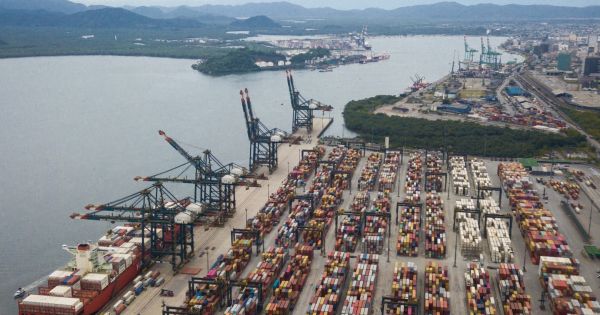
Brazil absorbed the hardest punch. Washington imposed additional tariffs reaching 50% on key Brazilian exports, carving roughly $1.5 billion out of U.S.-bound sales between August and December 2025 alone. Timber, metals, plastics, rubber, and fishing products bore the brunt of the measures. Total Brazilian exports to the United States dropped 6.6% across the full year, falling to $37.72 billion. For a country that counts the United States as its second-largest trading partner after China, those figures represent more than statistical noise—they signal structural disruption in supply chains built over decades.
Brasília responded by diversifying rapidly. Sales to China climbed 6%, European purchases increased 6.2%, and exports to Mercosur partners Argentina, Uruguay, and Paraguay surged 26.6%. Yet even with these pivots, Brazil closed 2025 with a trade surplus of $68.3 billion, the lowest in three years, according to data from Brazil’s Ministry of Economy. The shortfall reflects not just lost American demand but the challenge of replacing established relationships with new commercial arrangements that carry their own costs and complications.
A U.S. Supreme Court ruling in February 2026 struck down the original tariff framework, but the replacement proved only marginally better for Brazilian exporters. The new global scheme initially set rates at 10%, then jumped to 15% within twenty-four hours under Section 122 of the Trade Act. That legal mechanism, rarely deployed with such breadth, theoretically levels competitive conditions across supplier nations. In practice, it still raises input costs for American manufacturers and prices Brazilian goods out of certain market segments where margins were already thin.
Mexico’s experience followed a different trajectory. Excluded from the so-called “reciprocal” tariffs, it nonetheless faced a blanket 25% levy on imports. Washington later exempted 85% of goods covered by the USMCA free trade agreement negotiated during Trump’s first term. But steep rates persisted in strategic sectors: 50% on steel and aluminum, 25% on vehicles and auto parts, and 50% on copper products. These carve-outs preserve American industrial interests while maintaining nominal adherence to the trilateral pact. Mexican auto suppliers, clustered around Monterrey and Hermosillo, have been renegotiating contracts monthly as cost structures shift beneath them.
Argentina emerged as something of an outlier, using political proximity to secure economic concessions. President Javier Milei’s government, ideologically aligned with Washington on fiscal austerity and deregulation, negotiated a deal to eliminate tariffs on 1,675 products. The agreement awaits ratification, but Argentine exports to the U.S. market already grew nearly 29% in 2025, according to Argentina’s National Institute of Statistics and Census. That growth reflects not just tariff relief but expanded access in agricultural products where Argentina holds competitive advantages—soybeans, wine, and lithium compounds among them.
Uruguay cemented the United States as its fourth-largest export market with a 30% jump in 2025 shipments, heavily concentrated in beef. The Uruguayan Meat Institute reported steady demand from American distributors even as the 10% global tariff took effect. Paraguay, similarly dependent on beef exports and counting the United States as its third-largest destination, deemed the tariff manageable within existing profit margins. Both countries benefit from relatively narrow export portfolios where quality and supply reliability offset moderate price increases.
Colombia sustained and even grew its export volume, with the fishing sector expanding more than 11% according to the Colombian Ministry of Commerce. Nonetheless, roughly a third of Colombia’s exportable goods remain subject to tariffs, creating uneven conditions across industries. Coffee and cut flowers, two iconic Colombian exports, face different treatment depending on processing stages and import classifications. That complexity forces exporters to navigate a bureaucratic maze that adds time and cost to every transaction.
Chile secured an important exemption for copper, its dominant export and a critical input for American electronics and construction. But fruit, salmon, and timber shipments now carry higher costs that squeeze producers operating on seasonal cash flows. I visited a salmon processing facility outside Puerto Montt in January where managers were weighing whether to shift production toward Asian markets or absorb the tariff differential. The decision hinged on currency fluctuations, shipping logistics, and Beijing’s own trade policies—a multivariable equation with no stable solution.
Ecuador faces perhaps the most uncertain outlook. Economic growth projections for 2026 have been revised downward to 7%, partly due to tariff exposure on non-petroleum exports. President Daniel Noboa’s government announced a trade deal that will exempt 53% of non-oil exports, but the remaining portion includes bananas and shrimp, two sectors employing tens of thousands of workers in coastal provinces. The Ecuadorian Federation of Exporters estimates that without further relief, roughly 12,000 jobs could migrate to competing suppliers in Southeast Asia or Central America.
The Dominican Republic paid approximately $400 million in tariffs at the 10% rate and is actively negotiating a bilateral deal to reduce that burden. Tourism, the country’s largest dollar earner, remains unaffected, but manufactured goods from the free trade zones around Santiago and San Pedro de Macorís have lost competitiveness. Factory managers told me in February that some American clients were shifting orders to Vietnam and Bangladesh, where tariff structures remain more favorable even after accounting for longer transit times.
Bolivia, with minimal exposure to the U.S. market, has used the shifting landscape to reorient economic policy and court American investment in lithium extraction. The government in La Paz sees an opportunity to position Bolivia as a secure Western Hemisphere source for battery materials as Washington seeks to reduce dependence on Chinese supply chains. Whether that strategy yields concrete commitments remains to be seen, but it illustrates how smaller economies are reading the tariff regime as a signal to realign diplomatic and commercial priorities.
One year into this experiment, the clearest lesson is that tariff policy produces winners and losers not by economic logic alone but by political proximity, export concentration, and bureaucratic agility. Countries that could negotiate bilaterally or pivot quickly to alternative markets have weathered the storm. Those dependent on diversified exports to the United States, lacking either diplomatic leverage or flexible supply chains, have paid a measurable price. The long-term effects will depend on whether this tariff architecture becomes permanent or collapses under its own complexity. For now, exporters across the hemisphere are making contingency plans and hoping the next Supreme Court ruling doesn’t arrive on a Friday afternoon.