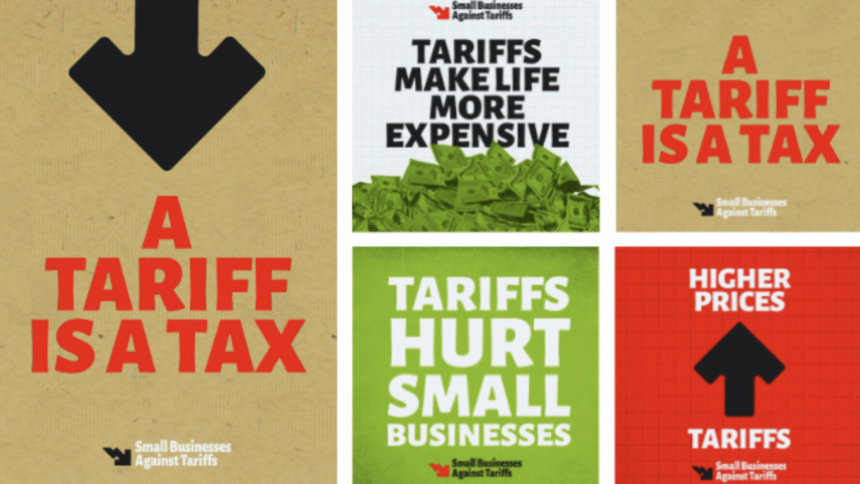
The ad campaign rolling out across five American cities this week isn’t selling a product. It’s trying to correct a fundamental misunderstanding about who pays when governments erect trade barriers. Small Businesses Against Tariffs, a nonpartisan coalition, is spending six figures to make one point clear: tariffs don’t punish foreign governments. They punish the people who buy and sell goods at home.
Atlanta is one of five targets for the month-long blitz, which includes posters, decals, and digital placements through April. The other cities—Chicago, Detroit, Nashville, and Newark—were chosen because their states absorbed the heaviest tariff costs during the Trump administration’s 2025 trade offensive. Georgia alone paid $7.1 billion in tariffs between February and December of last year, according to Trade Partnership Worldwide, an economic research firm that tracks cross-border commerce. That figure represents the accumulated cost of import fees on goods ranging from steel and aluminum to electronics and textiles. Those fees were paid by American companies importing materials or finished products, not by foreign exporters.
The confusion is widespread. A Council on Foreign Relations survey found that two out of five Americans believe tariffs are paid by the country exporting the goods. That’s not how tariffs work. When the U.S. imposes a 25% tariff on steel from Europe, European producers don’t write a check to the Treasury. The American company importing that steel does. That company then faces a choice: absorb the cost and shrink profit margins, or pass it on to customers through higher prices. Research from the New York Federal Reserve and Columbia University shows that nearly 90% of the tariffs enacted in 2025 were ultimately paid by U.S. firms and consumers.
For small businesses, the math is brutal. A furniture manufacturer in suburban Atlanta told me last year that tariffs on Malaysian plywood raised his material costs by 18%. He couldn’t absorb it. He raised prices, lost three contracts to competitors using domestic wood, and laid off two workers. A bakery supplier in Detroit saw the cost of imported mixers jump 30% due to tariffs on Chinese machinery. She delayed an expansion and cut employee hours. These aren’t abstract policy outcomes. They’re decisions made at kitchen tables and in back offices, where owners weigh survival against principle.
The Trump administration defended tariffs as a tool to protect American manufacturing and pressure trading partners into more favorable agreements. In some cases, tariffs did prompt renegotiations. The United States-Mexico-Canada Agreement, which replaced NAFTA, included new labor and environmental provisions. But the costs were real and immediate, while the benefits—if they materialized—were diffuse and delayed. The International Monetary Fund estimated that the 2025 tariff escalations shaved 0.3% off U.S. GDP growth, a modest but measurable drag on the economy.
Last month, the Supreme Court struck down the bulk of Trump’s tariff agenda, ruling that the administration had exceeded its legal authority under trade statutes. The decision was a win for business groups and trade advocates who argued the tariffs violated congressional oversight. But the legal victory came too late for companies that had already paid hundreds of millions in fees. Trump predicted that refund litigation would drag on for two years, and he wasn’t exaggerating. The process of determining who paid what, when, and under which tariff regime is a bureaucratic labyrinth.
In the meantime, Trump launched a new round of 10% global tariffs using a different legal pathway—one tied to national security that the Supreme Court decision didn’t touch. That maneuver kept pressure on trading partners but also kept costs elevated for importers. Earlier this month, a judge at the U.S. Court of International Trade ordered the administration to accelerate the refund process. U.S. Customs and Border Protection says it’s finalizing a four-step application system for companies seeking reimbursement. But the timeline remains unclear, and many small businesses lack the legal resources to navigate the claims process.
I reached out to the White House for comment on the ad campaign and to ask what message officials wanted to send to small businesses grappling with tariff costs. The press office didn’t respond. That silence is telling. Tariffs are politically complex. They appeal to voters who feel left behind by globalization and want Washington to take a harder line with China or Europe. But they also create losers at home, and those losers are increasingly vocal.
The ad campaign aims to shift the narrative by putting faces to the costs. One poster features a hardware store owner in Newark standing in front of empty shelves, with a caption explaining that tariffs on tools from Taiwan forced him to reduce inventory. Another shows a Nashville clothing boutique that closed after tariffs on Vietnamese textiles made her prices uncompetitive. These aren’t Fortune 500 companies with lobbying budgets. They’re Main Street operators caught between policy abstractions and rent payments.
Trade policy is always a blunt instrument. Tariffs can protect certain industries, but they distort markets and create unintended consequences. Economists generally agree that targeted tariffs on goods tied to national security or human rights abuses can be justified. Blanket tariffs on allies and adversaries alike are harder to defend, especially when domestic industries depend on imported inputs. A steel tariff might help a mill in Pennsylvania, but it hurts a car manufacturer in Michigan that needs affordable steel to stay competitive.
The Small Businesses Against Tariffs campaign won’t resolve the deeper debate over trade policy. But it might clarify one basic fact: when America raises tariffs, Americans pay the bill. Whether that’s a price worth paying depends on what you believe tariffs accomplish, and whether the costs are distributed fairly. For now, the posters going up in Atlanta this week are a reminder that policy doesn’t happen in a vacuum. It happens in warehouses, storefronts, and family budgets. And the people paying attention are starting to ask harder questions.