The morning of April 2, 2025, started like any other in the garment district of Ho Chi Minh City. By noon, factory owners were fielding panicked calls from American buyers. Donald Trump had just declared “Liberation Day”—a sweeping tariff regime that would upend decades of trade norms. Vietnam, a country that had spent years wooing U.S. manufacturers away from China, suddenly faced a 46% levy on its exports. The phone calls didn’t stop for weeks.
What followed wasn’t just an economic policy shift. It was a global scramble that revealed the fragility of modern supply chains and the limits of protectionist ambition. Nearly a year later, the data tells a story far messier than the White House promised. While Trump insisted tariffs would restore American manufacturing dominance, the evidence suggests something else entirely: a costly reshuffling that punished consumers at home while forcing exporters abroad into survival mode.
The scale of the April announcement was staggering. Every country except a handful with sanctions or specific exemptions faced at least a 10% baseline tariff. Eighty-five nations deemed to have trade surpluses with the U.S. were hit harder—some as high as 50%. Global markets tanked immediately. The Dow Jones dropped 1,800 points in two days. In Brussels, where I spoke with EU trade officials that week, the mood was bewildered disbelief. “This isn’t negotiation,” one diplomat told me off the record. “It’s economic hostage-taking.”
Within a week, Trump blinked. On April 9, he announced a 90-day pause on tariffs exceeding the 10% baseline. That breathing room became a frantic window for deal-making. The European Union dispatched teams to Washington. Vietnam’s trade minister practically set up camp at the U.S. Commerce Department. Even the United Kingdom, still nursing post-Brexit trade wounds, rushed to secure better terms. China, predictably, took the hardest line. What followed was a tit-for-tat escalation that saw tariffs spiral to 125% on certain goods—a level unseen since the Smoot-Hawley disasters of the 1930s.
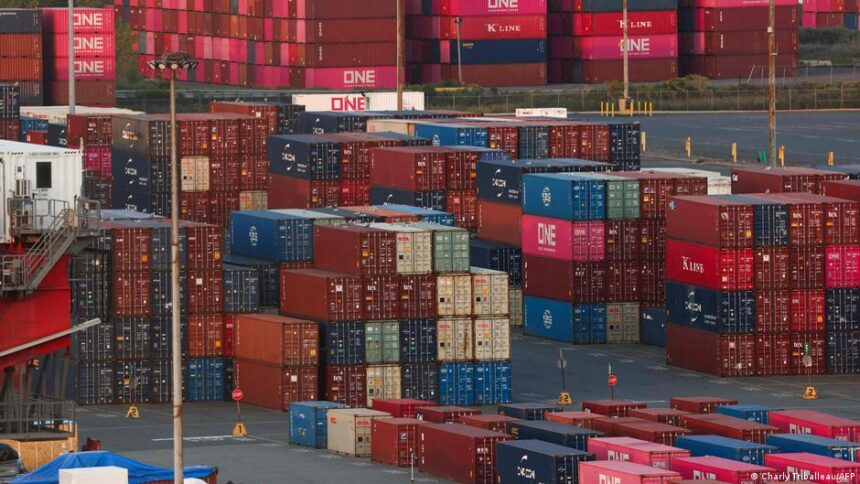
But American companies weren’t waiting for diplomacy to resolve itself. They had already seen this coming. Between January and March 2025, U.S. imports surged 20% above the 2022–2024 average—an additional $184 billion worth of goods crammed into warehouses. The rush was most visible in unexpected categories. Gold bullion imports exploded to 50 times their normal volume, hitting $72 billion. Switzerland supplied most of it, but suddenly Uzbekistan, the Philippines, and Zimbabwe appeared on import manifests. U.S. jewelers and investors were hedging against future costs in real time.
Taiwan, Vietnam, and India all saw their export numbers jump during this pre-tariff sprint. In Taipei, semiconductor manufacturers ran extra shifts to meet orders that might dry up once tariffs kicked in. One purchasing manager at a California tech firm described the strategy to me bluntly: “We bought everything we could afford to store. We knew the window was closing.”
When the 90-day pause began, the real adaptation started. Haishi Li, an economist at Hong Kong University who tracks trade flow disruptions, described the phenomenon simply: “Imports were like water, flowing from high-tariff countries to low-tariff countries.” His research team analyzed customs data from April through July and found companies systematically redirecting orders toward nations with lower levy rates.
China bore the brunt of this shift. U.S. imports from China dropped by $66 billion compared to the same period in previous years. Factories in Guangdong Province that had supplied American retailers for decades suddenly found orders canceled or redirected. In some cases, Chinese manufacturers opened shell operations in Vietnam or Thailand to reroute goods—an old trick, but one that gained new urgency.
Canada faced its own tariff threat—25% on most goods—and saw exports to the U.S. fall by $24 billion. Yet Canada’s overall trade picture remained relatively stable, down only $1.6 billion year-over-year. How? By aggressively diversifying. Canadian lumber, once destined overwhelmingly for American construction, found new buyers in Europe and Asia. Diplomats in Ottawa told me they’d spent months cultivating alternative markets, anticipating exactly this scenario.
Meanwhile, countries facing the baseline 10% tariff became relative winners. Australia, Brazil, and Argentina all saw modest gains. “The ‘10% countries’ benefited most from the tariff threat,” Li explained. But the story wasn’t straightforward even there. Taiwan faced a 34% tariff, Thailand 36%, Vietnam 46%—yet U.S. imports from Taiwan alone surged by $34 billion between April and July. Why? Because many manufacturers in these countries had already developed deep relationships with American buyers during Trump’s first-term trade war with China. Those established ties proved more valuable than tariff rates in the short term.
I spoke with a procurement director at a mid-sized electronics firm in Texas who summed up the calculus: “We know the Taiwanese suppliers. We trust their quality control. We’ve toured their facilities. Switching to a ‘10% country’ we’d never worked with felt riskier than eating the higher tariff.” That kind of institutional inertia—built on years of relationship capital—turned out to matter more than spreadsheet economics suggested it should.
Back in the United States, the promise that tariffs would revive manufacturing hasn’t materialized. Alex Durante, a senior economist at the Tax Foundation, has tracked domestic employment data closely. “This past year has been quite bad for manufacturing and employment,” he told me. “The sectors that are growing tend to be ones relatively insulated from the tariffs because of exemptions—like computers and AI-related products.”
The tariffs did generate revenue. In 2025, U.S. customs duties brought in $287 billion—roughly triple previous years and about 5% of total federal tax revenue. Early 2026 figures suggest the total will climb higher. But nearly every independent analysis concludes that U.S. importers, not foreign exporters, paid those duties. And importers passed costs downstream. The Tax Foundation estimates the tariffs effectively cost each American household around $1,000 in 2025 through higher prices, reduced wages, or fewer job opportunities.
I saw this firsthand in Mississippi, where a furniture manufacturer told me his lumber costs had jumped 18%. He’d been forced to lay off six workers and delay a planned expansion. “We’re not competing with China anymore,” he said bitterly. “We’re competing with everyone, and we’re doing it with one hand tied behind our backs.”
Internationally, uncertainty has become the defining feature of trade policy. After multiple extensions, country-specific tariff rates finally took effect on August 7, 2025. But the respite was brief. Since then, the White House has announced new levies on specific product categories, renegotiated and then abandoned deals, and issued threats that sometimes materialized and sometimes evaporated. In February, the U.S. Supreme Court struck down the legal framework underpinning the original “Liberation Day” tariffs. Trump responded by imposing a new 15% blanket rate and signaling he’d find alternative legal justifications for higher duties.
For exporters, this volatility is paralyzing. A Vietnamese textile executive told me his company now runs three separate production forecasts—optimistic, pessimistic, and catastrophic—and updates them weekly based on White House announcements. “We used to plan investments two years out,” he said. “Now we’re month to month.”
Economist Li believes governments will increasingly push companies to diversify away from U.S. dependence entirely. “If they can explore new markets and supply chains, it makes them more resilient,” he said. “That might be the silver lining.” Already, trade between Asian economies has accelerated. The European Union has fast-tracked agreements with Latin American blocs. Even Canada and Mexico, historically tethered to U.S. markets, are cultivating deeper ties with each other and with Pacific partners.
What’s emerging isn’t the reshoring of American manufacturing Trump promised. It’s a more fragmented global economy where the U.S. is no longer the automatic center of gravity. Companies are building redundancy into their supply chains, even if it costs more, because unpredictability has become its own expense. A logistics consultant in Singapore put it bluntly: “The U.S. market is still huge, but it’s no longer worth building your entire business around. That’s the real shift.”
The question now isn’t whether Trump’s tariffs achieved their stated goals—the data suggests they haven’t—but whether the global trading system can function amid this level of policy chaos. Importers, exporters, and governments are all making expensive adjustments to a new normal that keeps changing. The winners, if they exist at all, are those nimble enough to keep pivoting. Everyone else is just trying not to drown.