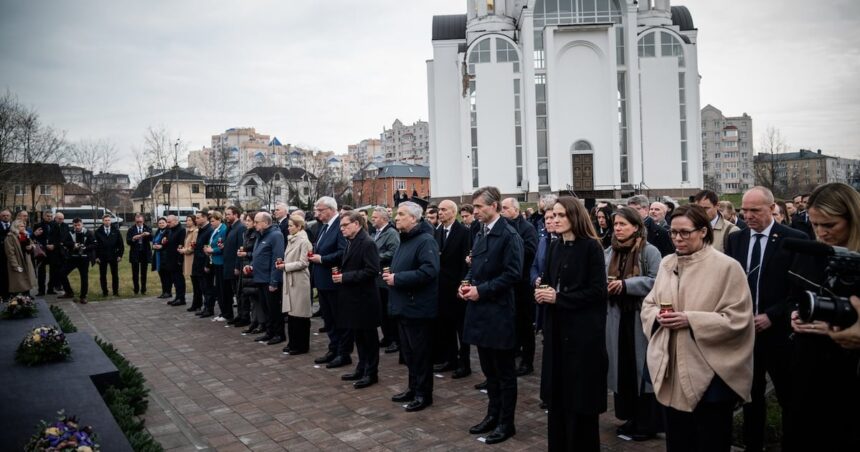
The train pulled into Kyiv on a Tuesday thick with memory. Twelve European foreign ministers emerged, their presence a deliberate political gesture timed to a date most of the world had already forgotten. April 1 marked four years since Russian forces withdrew from Bucha, leaving behind the kind of evidence that reshapes how wars are remembered.
More than 400 bodies were discovered when Ukrainian troops reclaimed the town in early April 2022. Many victims had been shot in the street. Some bore marks of execution-style killing—hands bound, close-range wounds. Others showed signs consistent with torture or sexual violence. The United Nations documented over 70 summary executions in what investigators characterized as systematic violence against civilians during the month-long occupation.
This anniversary visit wasn’t just ceremonial. European officials are wrestling with a geopolitical reality where Ukraine’s war has become background noise. U.S. diplomatic energy has pivoted sharply toward the Middle East conflict, stalling ceasefire negotiations that had shown marginal progress. Washington’s attention span for European security concerns appears to have reached its limit, leaving Brussels to shoulder diplomatic momentum that might otherwise dissipate entirely.
“We can’t let it slip off the table,” EU foreign policy chief Kaja Kallas told reporters during the journey to Kyiv. “We are the ones who have to keep this up because nobody else does.” Her language was blunt, almost resigned—an acknowledgment that Europe’s leverage in global diplomacy remains constrained by economic dependencies and internal political fractures.
At the Church of Saint Andrew in Bucha, the delegation viewed graphic documentation of the massacres. Polish Foreign Minister Radek Sikorski emerged from the exhibition visibly shaken. “Anybody who claims Vladimir Putin is not a war criminal should come and see for themselves,” he told the Associated Press. The moral clarity in his statement stands in sharp contrast to the legal complexities surrounding accountability. International Criminal Court procedures move glacially. Russia doesn’t recognize the court’s jurisdiction. And permanent Security Council members enjoy structural immunity from prosecution.
Ukrainian Foreign Minister Andrii Sybiha framed the visit as proof that “justice for this and other Russian atrocities is inevitable.” But inevitability requires mechanisms that don’t yet exist. The International Criminal Court has issued arrest warrants for Putin and other Russian officials, but enforcement depends on voluntary cooperation from member states. History suggests such warrants often become symbolic rather than actionable.
Kallas emphasized a principle that war crimes prosecutors repeat like a mantra: accountability must reach both those who pulled triggers and those who issued orders. “Otherwise, you have revenge and retaliation,” she explained. “If you don’t see people doing this to your family held accountable, you will want revenge.” This isn’t abstract philosophy. It’s the difference between post-conflict justice systems and generational cycles of violence. Bosnia, Rwanda, Cambodia—each demonstrates what happens when societies skip the accountability phase.
Europe’s commitment to Ukraine faces practical constraints that undermine the moral clarity of anniversary visits. Hungary blocked new EU sanctions on Russia last month, exploiting the bloc’s consensus requirement to protect Budapest’s economic interests. Prime Minister Viktor Orbán has also stalled a 90 billion euro loan package that Kyiv desperately needs as its treasury runs dry. Ukraine’s formal application for EU membership, meanwhile, follows a timeline measured in years rather than months—a bureaucratic reality that contrasts sharply with the urgency of its security situation.
Russia has calculated its own economic advantages with cold precision. Recent oil price surges, combined with temporary U.S. waivers on certain export restrictions, have generated windfall revenues for Moscow. Asian markets, particularly India and China, have increased purchases of Russian crude as global energy instability creates opportunities for discounted supplies. The International Energy Agency estimates Russia’s oil export revenues remained substantial despite Western sanctions, highlighting the limits of economic warfare when major economies refuse to participate.
Ukraine has responded with asymmetric tactics that strike directly at Russia’s revenue streams. Over the past week, Ukrainian drones targeted oil export infrastructure along the Baltic Sea. Strikes hit the Transneft terminal in Primorsk and the Novatek facility at Ust-Luga—critical nodes for shipping crude and petroleum products. Satellite imagery confirmed fires at both locations. Alexander Drozdenko, governor of the Leningrad region, acknowledged the attacks caused “unspecified damage,” the kind of vague official statement that usually means the impact was significant.
These drone campaigns represent strategic recalibration. Unable to match Russian firepower conventionally, Ukraine has invested in long-range capabilities that bypass front-line stalemates. The economic logic is straightforward: every barrel of oil that doesn’t reach export terminals reduces funding for Russian military operations. But the tactic also carries risks. Escalation patterns in this war have consistently surprised analysts who assumed rational cost-benefit calculations would impose limits.
European officials gathered in Bucha face an uncomfortable truth that diplomacy rarely acknowledges openly. Their visit generates headlines but changes no battlefield equations. Russian forces continue grinding advances in eastern Ukraine. Casualty rates remain horrific on both sides. And the international community has largely accepted that this war will end through exhaustion rather than decisive victory for either side.
“The talks are stalled,” Kallas admitted when asked about U.S.-mediated negotiations. Washington hasn’t formally withdrawn from diplomatic efforts, but the pause feels indefinite. Middle East dynamics absorb the bandwidth that Ukraine diplomacy requires. Air defense systems that Kyiv needs are being diverted or delayed. The geopolitical attention economy operates with brutal efficiency—only so many crises can occupy front pages simultaneously.
Standing among the exhibits documenting Bucha’s atrocities, the European delegation confronted evidence that resists political spin. Forensic reports, survivor testimonies, mass grave excavations—the documentation forms an archive that will outlive current diplomatic strategies. Whether that archive eventually serves justice or simply memorializes failure depends on political will that hasn’t yet materialized. The ministers departed by train that evening. Memory work had been performed. The war continued.