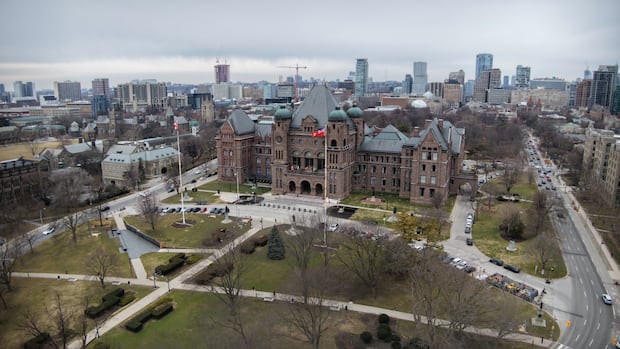
When Peter Bethlenfalvy stood in the Ontario legislature Thursday to table the province’s latest budget, he wasn’t just reading numbers off a spreadsheet. He was sketching out what happens when the ground beneath your economy starts to shift. And in 2025, that ground is moving fast.
The Ford government’s eighth budget arrives at a moment when Ontario’s export-dependent economy faces something it hasn’t dealt with in decades: the realistic possibility that the United States could walk away from the Canada-U.S.-Mexico Agreement. That’s CUSMA for short, the trade framework that has governed cross-border commerce since 2020. Trump called it “irrelevant” earlier this week at a Ford plant in Michigan. That word choice wasn’t accidental.
Ontario ships roughly three-quarters of its exports south. Cars, steel, aluminum, machinery—billions of dollars’ worth of goods cross the Ambassador Bridge and other border points every month. Much of that flow has been shielded from Trump’s tariff volleys because it falls under CUSMA’s duty-free provisions. But if the U.S. pulls out during this year’s mandatory review, that shield disappears.
The province’s response is a contingency fund that grows over three years. It starts at $1.5 billion in 2026-27, climbs to $2 billion the following year, and hits $2.5 billion by 2028-29. That’s two to five times the usual reserve Ontario keeps for unexpected shocks. The message is clear: this isn’t just another trade spat that fades after a few headlines.
Bethlenfalvy described the budget’s stance as “cautiously optimistic yet prudent.” Translation: we hope for the best, but we’re bolting the doors just in case. The finance minister noted that when they finalized the numbers, there was no active war between the U.S. and Iran. That conflict has since closed the Strait of Hormuz, throttling energy shipments and spiking gas prices across Canada. Global risks aren’t theoretical anymore—they’re showing up at the pump.
The budget lays out a downside scenario worth understanding. If the U.S. withdraws and slaps a 12 percent tariff on Canadian goods while keeping existing tariffs in place, Ontario’s economic growth would slow from a projected one percent in 2026 to just 0.3 percent. That’s barely moving. Growth would inch back to 0.6 percent in 2027, still anemic by historical standards.
To put that in perspective, Ontario’s economy is worth roughly $1 trillion. A growth gap of 0.7 percent translates to billions in lost activity—fewer jobs created, less tax revenue, tighter provincial finances. The auto sector would take the hardest hit. Ontario assembles vehicles for Ford, GM, Stellantis, Honda, and Toyota. Those plants rely on intricate supply chains that stretch across borders. Tariffs don’t just raise costs—they snarl logistics and force companies to rethink where they build.
Thousands of layoffs have already hit Ontario’s auto, steel, and aluminum industries as existing tariffs bite. Trump’s trade war hasn’t been hypothetical for those workers. It’s been pink slips and closed shifts. The budget acknowledges that reality without sugar-coating it.
Trade talks between Washington and Ottawa restarted this month after Trump abruptly called them off in October. The trigger, reportedly, was an anti-tariff ad campaign run by Ford’s government. That episode underscores how fragile the situation remains. Diplomacy can pause over a 30-second spot. Agreements can unravel over rhetoric.
But CUSMA isn’t the only risk shadowing Ontario’s fiscal outlook. The budget flags geopolitical tensions as a broader threat. Escalation in the Middle East or Ukraine could disrupt major shipping routes and supply chains. The Strait of Hormuz closure is already a case study in how regional conflict ripples outward. Jet fuel prices have surged. Container ships are rerouting. Goods that used to take weeks now take months.
The budget also points to potential instability in Asia and Latin America as wildcards. These aren’t idle concerns. Taiwan produces most of the world’s advanced semiconductors. Mexico is a critical manufacturing hub. Political or military disruptions in either region would hammer Ontario’s tech and auto sectors.
Then there’s artificial intelligence, which the budget treats with a kind of dual personality. On one hand, Ontario sees AI as a major economic opportunity. The province is renewing its Critical Technology Initiatives Program with $107 million over three years starting in 2026-27. That funding aims to keep Ontario competitive as AI reshapes industries from finance to healthcare to logistics.
On the other hand, the budget’s risk assessment includes a caveat: AI’s promise might not pan out as expected. That’s a rare note of skepticism in a sector drowning in hype. Investment in AI has surged globally, but actual productivity gains remain hard to measure. If the technology disappoints—or if regulatory backlash stalls deployment—Ontario could find itself nursing a capital hangover without much to show for it.
That kind of hedging reflects the broader tone of this budget. It’s not pessimistic, but it’s not cheerleading either. Bethlenfalvy’s framing—“the world has changed, and we must change with it”—captures that middle ground. Ontario is trying to prepare for scenarios that range from uncomfortable to painful, without assuming the worst is inevitable.
The contingency funding is the clearest signal of that mindset. Most years, Ontario sets aside $500 million to $1 billion for emergencies. Tripling that baseline suggests the province is bracing for something bigger than a typical downturn. It’s planning for disruption that could reshape trade relationships, supply chains, and industrial strategy all at once.
Whether that preparation proves sufficient depends on variables Ontario can’t control. Trump’s next move on CUSMA. How long the Strait of Hormuz stays closed. Whether AI delivers on its promises or just inflates another tech bubble. The budget doesn’t pretend to have answers. It just acknowledges the questions are getting harder.
For Ontario’s workers and businesses, that means navigating a stretch of deep uncertainty. The rules that governed trade for the past five years might not hold. The supply chains that seemed reliable might fracture. The technologies that promised growth might underwhelm. Planning in that environment isn’t about optimism or pessimism—it’s about flexibility and resilience.
Bethlenfalvy’s budget tries to build some of both. Whether it’s enough will depend on forces well beyond Queen’s Park.