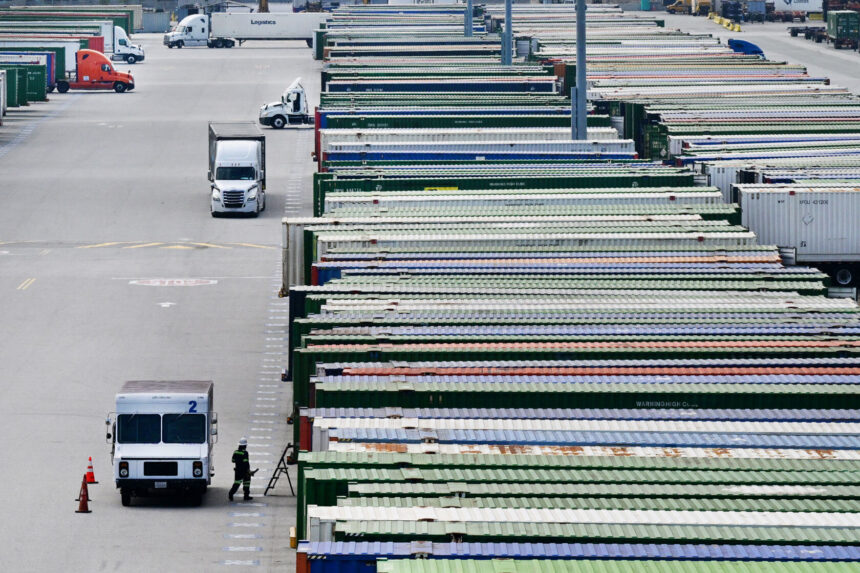
I stood outside a warehouse in Dayton, Ohio last month, watching a forklift operator named Carlos unload pallets of industrial fasteners from Taiwan. His boss, the owner of a 22-employee hardware distributor, told me his tariff bill had jumped from $14,000 a month to nearly $40,000. “We’re bleeding,” he said, lighting a cigarette in the March cold. “And nobody in Washington seems to care.”
That conversation echoes across the country as President Trump’s tariff experiment approaches its one-year mark. What began as “Liberation Day” on April 2, 2025—a promise to supercharge American manufacturing—has instead transformed into an expensive lesson in economic pain for the nation’s smallest importers. New data from the Center for American Progress reveals that small businesses importing goods now pay an average of $306,000 more in tariffs than they did before Trump’s trade war began. That’s $25,000 extra every single month, money that comes straight out of operating budgets, expansion plans, and sometimes paychecks.
The numbers tell a story the White House refuses to acknowledge. During his February State of the Union address, Trump insisted that foreign countries pay these tariffs. But walk into any small business that imports components, materials, or finished goods, and you’ll hear a different reality. Federal Reserve surveys show more than four in ten small firms report tariff-related price increases affecting their operations. Economic research confirms roughly 90 percent of 2025’s tariff costs landed on American importers and consumers, not overseas exporters. The president’s talking point doesn’t match what’s happening in warehouses, retail shops, and manufacturing floors from Seattle to Savannah.
Trump’s tariff blitz actually started in March 2025, before the dramatic Liberation Day announcement. That month, his administration slapped 25 percent duties on many Canadian and Mexican imports, exempting only goods qualifying under the existing trade agreement. Additional tariffs hit steel and aluminum under national security provisions. Then came April’s sweeping country-specific tariffs, effectively launching trade hostilities with nearly every trading partner simultaneously. Customs revenue exploded from typical monthly collections to over $30 billion per month by August 2025, a level that persisted into 2026.
Small businesses represent the backbone of American commerce, employing nearly half the workforce and creating 1.2 million jobs in 2025 alone. Of 36.2 million small businesses nationwide, roughly 236,000 are importers. These firms may be small by employee count, but they handle about 32 percent of the known value of U.S. imports. That’s nearly a third of everything America brings in from abroad, flowing through companies with fewer than 500 workers. When tariff rates triple, these businesses absorb the shock with far less cushion than multinational corporations.
The financial impact varies by size, but nobody escapes unscathed. Mom-and-pop operations with under 50 employees paid approximately $175,000 in additional tariffs over the past year. Larger small businesses hit that $306,000 average. Monthly payments that once ran $14,000 now approach $37,000. I’ve interviewed business owners who describe the increase as existential. A furniture importer in North Carolina told me she’s considering closing after 18 years because her Vietnamese suppliers can’t lower prices enough to offset the tariff surge, and her customers won’t pay 30 percent more for the same sofa.
In February 2026, the U.S. Supreme Court struck down Trump’s Liberation Day tariffs as illegal, ruling he lacked authority under the International Emergency Economic Powers Act to impose them. Rather than reassess his strategy, Trump immediately ordered a new 10 percent across-the-board tariff under different legal authority, threatening to raise it to 15 percent. This 150-day measure buys time for his administration to craft permanent tariffs under Section 301 of the Trade Act of 1974. For embattled small businesses, the Supreme Court decision brought no relief, just a brief pause before another wave.
Geography matters in this crisis. Kentucky, Michigan, and Tennessee importers face average additional costs exceeding $650,000 per business, reflecting these states’ heavy reliance on manufacturing supply chains and imported components. Wisconsin small importers paid $272,000 more on average. Fifteen states exceed the national average burden. Kentucky’s economy draws nearly one-third of its GDP from imports, meaning tariff shocks ripple through entire communities. When a Louisville auto parts distributor pays double for Mexican components, that cost flows to repair shops, then to customers who delay fixing their cars, then to mechanics who see fewer billable hours.
The political promise was simple: tariffs would revive American factories and punish foreign competitors. The reality is considerably messier. Manufacturing has struggled under these policies rather than flourished. Meanwhile, small-business bankruptcies climbed 11 percent in 2025, a stark indicator of the financial stress Trump’s trade agenda has created. A March 2026 survey from Small Business Majority found 53 percent of small businesses experienced increased supplier costs, with 47 percent reporting higher prices for materials or products. These aren’t abstract statistics; they represent hard decisions about whether to raise prices, freeze hiring, cancel expansions, or shut down entirely.
I spoke with a Chicago electronics retailer who described the impossible math. His Chinese suppliers raised prices 20 percent to cover tariffs. He raised his retail prices 12 percent, absorbing the rest, and watched sales drop 18 percent as customers shopped online for cheaper alternatives. He laid off three of his eleven employees. “I voted for Trump,” he told me. “I thought he understood business. But this isn’t helping me compete. It’s killing me.”
The tariff burden spreads across all 50 states and the District of Columbia, though its intensity varies. States with robust import economies and manufacturing sectors feel the squeeze most acutely. But even in states less dependent on imports, small businesses that rely on foreign components or finished goods confront higher costs and difficult choices. A Montana sporting goods shop that imports camping equipment from Vietnam, a Maine seafood processor buying Canadian product, a Texas electronics repair shop sourcing Asian parts—all face the same upward cost pressure.
What makes this especially frustrating for affected businesses is the disconnect between their lived experience and official rhetoric. White House statements continue celebrating tariff revenue as if it represents foreign tribute rather than domestic taxation. Treasury data shows customs duties generated massive increases, jumping from pre-2025 levels to sustained monthly totals above $30 billion. But that revenue doesn’t appear magically. It comes from American companies writing larger checks to U.S. Customs and Border Protection, then scrambling to cover those costs through some combination of reduced profits, higher prices, lower wages, or reduced investment.
The promised industrial renaissance hasn’t materialized either. While some domestic producers gained temporary competitive advantages, the broader manufacturing sector faces headwinds from disrupted supply chains and retaliatory tariffs other countries imposed on American exports. A Wisconsin dairy equipment manufacturer explained that while his Korean competitors’ prices rose due to tariffs, his own costs increased because he imports specialized steel and electronic components. He gained nothing from the tariff protection because his input costs rose proportionally. Meanwhile, Mexico imposed retaliatory tariffs on U.S. dairy exports, shrinking his customer base.
Tariff policy operates in the real world among complex global supply chains built over decades. Modern manufacturing rarely involves purely domestic production. A “Made in America” product typically incorporates foreign components, materials, or subassemblies. When tariffs increase costs across entire supply chains, even domestic manufacturers face higher expenses. The illusion that tariffs simply make foreign goods more expensive while leaving domestic production unaffected ignores how twenty-first century commerce actually functions.
Small businesses operate on thin margins even in good times. Unlike large corporations with diverse revenue streams and substantial cash reserves, small importers lack buffers to absorb sudden cost spikes. The $306,000 average increase represents a devastating hit for businesses where annual profits might total $100,000 or $200,000. Some businesses responded by switching to domestic suppliers, only to discover American alternatives cost even more than the tariffed foreign goods. Others searched for suppliers in countries with lower tariff rates, a time-consuming process that often produces inferior products or unreliable service.
The human cost extends beyond business owners to their employees and communities. When small businesses struggle, they delay wage increases, reduce hours, postpone hiring, or lay off workers. They cut back on community sponsorships, charitable contributions, and local investment. A thriving small business generates ripple effects throughout its community. A struggling one pulls back, and those effects ripple outward too. The Dayton hardware distributor I visited in March had already eliminated one position and frozen wages. “I feel terrible,” the owner said. “These folks have families. But I can’t run a charity when my costs keep climbing.”
Looking ahead, the path forward remains unclear. Trump’s new 10 percent tariff and planned permanent increases suggest no policy reversal forthcoming. International negotiations have produced minimal progress, with most trading partners refusing to capitulate to demands they view as unreasonable. The World Trade Organization process moves slowly. Congress shows little appetite for constraining presidential tariff authority despite the Supreme Court’s rebuke. Small businesses face the prospect of elevated tariff costs extending indefinitely into the future.
Some economists argue that short-term pain might eventually produce long-term gains if tariffs successfully rebuild American manufacturing capacity. But that argument provides cold comfort to business owners facing bankruptcy this quarter. It also assumes tariffs will achieve their stated goal, an assumption undermined by the evidence so far. The most likely outcome appears to be sustained higher costs for American businesses and consumers without corresponding domestic industrial revival, the worst of both worlds.
The tariff burden also reflects broader questions about whose interests trade policy serves. Large corporations with sophisticated supply chain management and global footprints can shift sourcing, absorb costs, and lobby for exemptions more effectively than small businesses. The latter lack Washington connections, can’t afford trade lawyers, and possess limited flexibility to restructure their operations. They’re price-takers in a policy environment shaped by political considerations rather than economic logic. When politicians promise to protect American workers through tariffs, small business owners and their employees often end up as collateral damage.
Small businesses tell pollsters that rising costs remain their top financial challenge, a predictable result when tariff bills triple overnight. Yet policy makers seem largely indifferent to their concerns, focused instead on geopolitical posturing and campaign talking points. The disconnect between Pennsylvania Avenue and Main Street has rarely felt wider. I’ve covered international trade policy for two decades, and I’ve never seen such a stark gap between official claims of success and ground-level reports of suffering.
What’s needed is honest assessment of whether current tariff policy achieves its objectives and at what cost. If the goal is reviving American manufacturing, does tripling small-business import costs accomplish that? If the aim is strengthening national security, do tariffs on Canadian aluminum and Mexican auto parts enhance America’s strategic position? If the purpose is generating federal revenue, is forcing small businesses toward bankruptcy an acceptable method? These questions deserve serious debate rather than dismissive rhetoric about foreign countries paying the bill.
Carlos, the forklift operator in Dayton, asked me whether things would get better. I told him I didn’t know. His boss had already warned the staff about potential layoffs if costs didn’t stabilize. Carlos supports three kids on his warehouse wages. He doesn’t follow trade policy closely, doesn’t understand the legal authorities Trump claims, can’t explain the difference between Section 232 and Section 301 tariffs. He just knows his job might disappear because of decisions made in Washington by people who’ve never operated a forklift or worried about making rent. That’s the real story of Trump’s tariff experiment: abstract policy creating concrete pain for Americans who never asked for this fight.