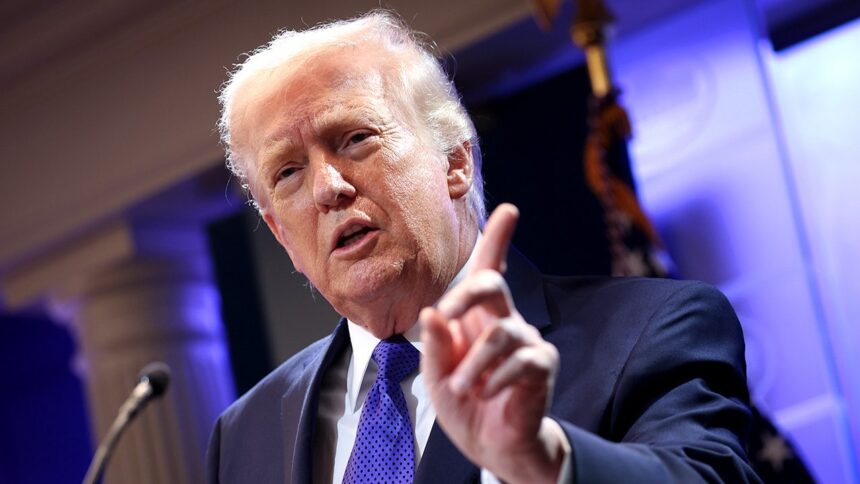
The backlash came fast and blunt. Speaking to a room full of Republican donors in Washington, President Donald Trump didn’t soften his words when discussing the Supreme Court justices he personally placed on the bench. Two of them, he said, now “sicken” him. He didn’t use their names that night, but everyone knew who he meant: Neil Gorsuch and Amy Coney Barrett. Their crime, in his view, was siding with a 6–3 majority decision last month that effectively dismantled his legal justification for sweeping tariffs imposed under emergency powers. The ruling concluded that the International Emergency Economic Powers Act does not grant the president authority to unilaterally levy import duties the way Trump tried to do.
It’s not often that a sitting president attacks his own Supreme Court appointees so publicly. Trump has criticized judges before, including federal district courts and even Chief Justice John Roberts. But this felt different. These were justices he championed, whom he celebrated as ideological victories during his first term. Now, according to Trump, they’ve betrayed not just him but the entire country. “Bad courts in this country are costing us a tremendous amount of money,” he said at the National Republican Congressional Committee dinner. “The Supreme Court, that’s right, of the United States, cost our country — all they needed was a sentence — our country hundreds of billions of dollars, and they couldn’t care less.”
The legal dispute centered on Trump’s so-called “Liberation Day” tariffs rolled out in April. Designed to reduce trade deficits and decrease dependence on foreign manufacturing, the tariffs represented one of the boldest economic policy moves of his second term. Revenue surged almost immediately. Treasury data shows duties jumped from $9.6 billion in March to nearly $24 billion by May. Over fiscal year 2025, total tariff collections hit $215.2 billion, and the numbers kept climbing into 2026. But the Supreme Court wasn’t convinced the law Trump cited gave him that kind of power. The majority opinion, delivered by Chief Justice Roberts, argued that emergency economic powers don’t include unilateral authority to impose tariffs without clearer congressional authorization.
Trump’s frustration isn’t just political theater. Tariffs have been central to his economic vision since his first campaign. He’s long framed trade policy as a matter of national security and industrial sovereignty, not just commerce. Losing the legal foundation for that agenda represents more than a courtroom defeat. It challenges his ability to govern on one of his signature issues. In his remarks, Trump said he felt “ashamed of certain members of the court, absolutely ashamed, for not having the courage to do what’s right for the country.” That language—courage, shame, sickness—speaks to a deeper belief that judicial independence, in this case, amounted to cowardice or worse.
Chief Justice Roberts, for his part, has pushed back against the growing trend of personal attacks on federal judges. Speaking earlier this month at a Rice University event, he warned that criticizing legal reasoning is fair game, but targeting judges personally crosses a dangerous line. “The problem is that sometimes the criticism can move from a focus on legal analysis to personalities,” Roberts said. “And that, frankly, can actually be quite dangerous.” He didn’t mention Trump by name, but the timing wasn’t subtle. Roberts has been walking a tightrope for years, trying to preserve the Court’s institutional legitimacy while navigating an era of hyper-polarized politics. His message was clear: judges aren’t politicians, and treating them like campaign opponents erodes public trust in the judiciary.
But Trump isn’t pulling back. Since the ruling, he’s moved to impose a separate 10% global tariff under Section 122 of trade law, layering it on top of existing duties. That legal pathway is narrower and more vulnerable to future challenges, but it signals his determination to push forward regardless of judicial pushback. The question now is whether Congress will step in to either authorize his tariff strategy more explicitly or rein it in. So far, Republican leaders have stayed mostly quiet. Some privately acknowledge discomfort with Trump’s rhetoric toward the Court, but few are willing to publicly break with him on trade policy, which remains popular with the base.
Legal scholars are watching closely. If Trump continues attacking justices by name, especially his own appointees, it could shift how future presidents interact with the judiciary. The norm has always been to disagree with rulings, not demonize judges. But norms have been bending for years, and Trump has never been one to honor them when they stand in his way. Gorsuch and Barrett, both known for textualist and originalist legal philosophies, likely saw the tariff case as straightforward statutory interpretation. The law didn’t say what Trump needed it to say. For them, that was the end of the analysis. For Trump, it was betrayal.
International trade partners are also recalibrating. The European Union, China, and Mexico have all threatened retaliatory measures if Trump’s new tariffs take full effect. The International Monetary Fund recently warned that escalating trade barriers could shave nearly half a percentage point off global GDP growth in 2026. Businesses caught in the middle are lobbying both the White House and Congress, trying to carve out exemptions or delay enforcement. The uncertainty is starting to show up in supply chain decisions. Some manufacturers are shifting production back to the U.S. to avoid tariffs, which is exactly what Trump wants. Others are simply raising prices and passing costs to consumers.
What remains unclear is how this standoff ends. Trump’s base largely supports his trade agenda, viewing tariffs as a tool to protect American jobs and punish unfair competition. But his attacks on the Supreme Court risk alienating constitutional conservatives who value judicial independence above policy wins. That coalition has been fragile since his first term, and this latest episode tests it again. Gorsuch and Barrett haven’t responded publicly, and they likely won’t. Justices rarely engage in political fights, especially with the president who appointed them. Their silence, though, won’t stop the fallout. Trump’s words carry weight, and his supporters are already questioning whether the justices can be trusted going forward.
The broader implications stretch beyond tariffs. If a president can openly vilify Supreme Court justices without meaningful pushback from their own party, the Court’s role as an independent check on executive power weakens. That’s not a partisan concern. It’s a structural one. Future presidents, regardless of party, will take note. The line between legitimate criticism and personal intimidation is blurring, and once it’s gone, it’s hard to redraw. Roberts knows this, which is why he’s speaking out more than usual. But words from the bench don’t carry the same force as actions from Congress or the executive branch. And right now, neither seems inclined to defend the Court’s autonomy when it conflicts with political priorities.