The morning I first heard the term “energy imbalance,” I was sitting in a small research station on Haida Gwaii, watching a climatologist trace temperature graphs on a whiteboard. Outside, the March rain drummed against cedar trees older than Canada itself. She drew two arrows—one pointing down from the sun, one pointing up from the Earth. “These used to match,” she said quietly. “Now they don’t.”
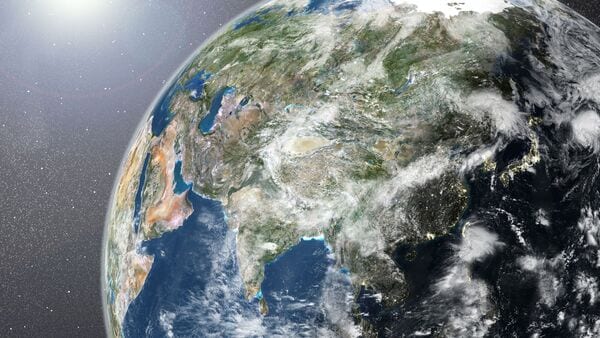
That conversation came back to me when the World Meteorological Organization released its 2025 State of the Global Climate report this past March. Buried in the data, between rising sea levels and melting ice sheets, was something new. The report now tracks what scientists call the Earth’s energy imbalance. It measures how much heat our planet absorbs from the sun versus how much it releases back into space. For most of human history, those numbers stayed roughly equal. Not anymore.
The WMO report confirms what many researchers have suspected. The imbalance has grown steadily since scientists began tracking it in 1960, with the sharpest increase coming in the last two decades. In 2025, it reached a new peak. The culprit is straightforward. Greenhouse gases like carbon dioxide, methane, and nitrous oxide now fill our atmosphere at concentrations unseen in at least 800,000 years. These gases act like a thickening blanket, trapping more heat than the planet can release.
In 2024, atmospheric carbon dioxide measured 423.9 parts per million. By early 2026, NASA recorded it climbing to roughly 428 ppm. To understand what that means, consider this context. Throughout the entire span of human existence, CO2 levels never exceeded 300 ppm. During the baseline period of 1850 to 1900, before large-scale industrial coal burning, the level sat at 278.3 ppm. Last year’s reading represents 152 percent of what scientists estimate existed in 1750. The atmosphere now holds about 3.306 gigatons of carbon dioxide.
I spoke with Dr. Miriam Chen, an oceanographer at the University of British Columbia, about what happens to all that trapped heat. “People think climate change is just about hot summers,” she told me over coffee near the campus. “But we’re only feeling a fraction of it.” Her research focuses on ocean heat absorption, and the numbers she shared were staggering. Of all the excess heat trapped by greenhouse gases, humans directly experience only about one percent through the warming atmosphere. Land surfaces absorb roughly five percent. Another three percent goes toward melting mountain glaciers and polar ice. The remaining 91 percent disappears into the ocean.
The global ocean has become an enormous heat sink, absorbing energy at rates that doubled between 2005 and 2025 compared to the previous 45 years. Ocean heat content set a new record high in 2025, according to the WMO. Warmer waters fuel stronger hurricanes and cyclones. Rising acidity threatens coral reefs and disrupts marine ecosystems that billions of people depend on for food and livelihood. As ice melts and seawater expands from heat, coastal communities face an uncertain future.
The report catalogs other breaking points. The eleven hottest years ever recorded all occurred between 2015 and 2025. Last year ranked as the hottest, with 2025 coming in second or third depending on the dataset. Global average temperature in 2024 reached 1.43 degrees Celsius above preindustrial levels. We’re approaching the 1.5-degree threshold that climate scientists have long warned represents a critical boundary.
What troubles researchers most is that 2025 stayed scorching despite La Niña conditions. This natural climate pattern typically cools sea surface temperatures across the equatorial Pacific, which influences weather systems worldwide. Its opposite, El Niño, tends to raise global temperatures. The record-breaking heat of 2024, when temperatures hit 1.55 degrees Celsius above baseline, happened during an El Niño cycle. Scientists now worry that when El Niño conditions return later this year, 2027 could shatter existing records as accumulated trapped heat compounds with natural warming.
I’ve covered enough climate stories to recognize when data crosses from abstract to urgent. WMO Secretary-General Celeste Saulo described how our fossil fuel dependence “increasingly disrupts the natural equilibrium.” The consequences, she noted, will persist for hundreds and thousands of years. UN Secretary-General António Guterres was more direct. “Every key climate indicator is flashing red,” he said in response to the report. “Humanity has just endured the 11 hottest years on record. When history repeats itself eleven times, it is no longer a coincidence.”
The impacts ripple everywhere. Rising atmospheric heat damages crop yields and threatens food security. Extreme weather events intensify. Coral reefs bleach and die. Coastal cities plan for futures shaped by rising seas. The planet’s capacity to maintain stable climate systems is being pushed past sustainable limits.
Some effects are now locked in regardless of future action. Ocean heat will continue affecting weather patterns for decades. Ice melt will keep raising sea levels. Ecosystems will struggle to adapt to rapid change. But the difference between difficult and catastrophic still depends on choices made now. Climate models show that continued fossil fuel dependence could push warming to three or four degrees Celsius by 2100. That scenario threatens food systems, displaces hundreds of millions of people, and reshapes coastlines globally.
Guterres connected climate stress to broader security concerns. “In this age of war, climate stress is also exposing another truth,” he said. “Our addiction to fossil fuels is destabilizing both the climate and global security.” His assessment of the WMO report was blunt. “Climate chaos is accelerating and delay is deadly.”
The solutions remain the same ones scientists and communities have advocated for years. Transition away from coal, oil, and gas. Invest in renewable energy infrastructure. Protect forests and wetlands that naturally absorb carbon. Support communities already experiencing climate impacts. The technology exists. The knowledge exists. What’s been missing is the political will to act at the necessary scale and speed.
Back on Haida Gwaii, before I left the research station, the climatologist showed me projections of what the imbalance could look like by mid-century under different scenarios. One pathway showed the arrows beginning to balance again. It required rapid emission cuts starting immediately. The other pathways showed the gap widening. “We know what happens then,” she said. “We’re already seeing it begin.”
The WMO report should have dominated headlines. Instead, it appeared briefly and faded beneath other crises. But the data doesn’t care about news cycles. The energy imbalance keeps growing. The heat keeps accumulating. And every fraction of a degree makes the next one harder to prevent. The Earth is telling us something fundamental has changed. The question is whether we’re ready to listen.