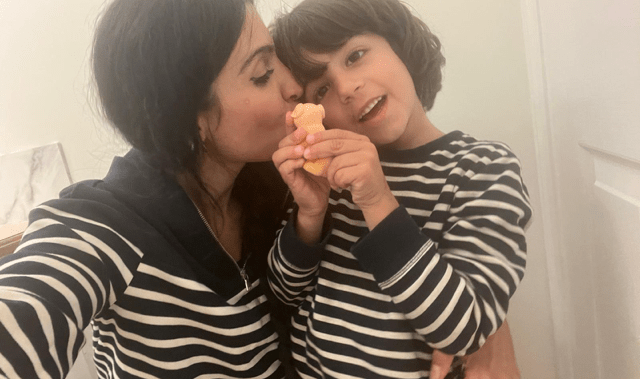
The train from Frankfurt to the small German clinic takes ninety minutes. Natasha Hepburn has memorized the route. She’s studied the treatment protocol. She’s read every paper Dr. Rene Chabot has published on transvenous embolization. But she hasn’t boarded that train yet. On Monday, the British Columbia government denied funding for her eight-year-old son Nathan to receive treatment that could save his life.
Nathan has brain arteriovenous malformation, known as AVM. The condition creates tangled, abnormal blood vessels in the brain that can rupture without warning. When they do, the bleeding can cause permanent brain damage or death. Natasha describes it as a ticking time bomb inside her son’s head. The clock is running, and she doesn’t know how much time she has left.
The denial letter cited two main reasons. First, that appropriate medical care is available in British Columbia or elsewhere in Canada. Second, that the treatment Nathan needs is experimental or unproven. Natasha sat at her kitchen table and read those words over and over. She felt numb, then devastated, then something harder to name. She had believed the system would see what she sees: a child who has run out of options at home.
Nathan has already tried the conventional approaches. Doctors at BC Children’s Hospital performed embolization, a procedure where they inject material into blood vessels to block them. It didn’t work. Nathan received radiation therapy. The scans showed no change. His lesion remained the same size, with the same dangerous characteristics. The medical team in Vancouver did everything they could, and Natasha is grateful for their care. But Nathan’s AVM is different. Its biology resists the treatments available in Canada.
That’s when Natasha found Dr. Chabot’s work. The interventional radiologist has pioneered a new embolic agent called Obtura, which functions like medical glue. When a brain vessel bleeds, the glue can be injected to stop the hemorrhage or seal the malformation entirely. Chabot has also refined a technique called transvenous embolization, approaching complex lesions from a different angle than traditional methods. He’s treated cases like Nathan’s more than fifty times. He told Natasha he’s highly confident he can cure her son.
The cost is about sixty-one thousand dollars per treatment. Nathan may need between three and five sessions. Natasha applied for Out-of-Country Health Funding through British Columbia’s Medical Services Branch. She submitted letters from Nathan’s doctors at BC Children’s Hospital and from specialists at Toronto’s SickKids Hospital. All of them wrote that they could do nothing more for Nathan in Canada. They supported the family’s decision to seek treatment abroad.
John Hepburn, Nathan’s grandfather and Dean Emeritus of Science at the University of British Columbia, describes the situation as a catch-22. If a treatment isn’t available in Canada, there’s no one qualified to perform it here. That means no one applies for Health Canada approval. Without that approval, the provincial government won’t fund patients to receive the treatment elsewhere. The very fact that a procedure is practiced successfully in Germany but not in Canada becomes the reason to deny funding.
John takes issue with calling Chabot’s method experimental. As a scientist, he knows what that word means. Experiments are tests with unknown outcomes. Chabot’s technique has been documented in peer-reviewed medical literature. It’s been successful well over a hundred times. The treatment isn’t a gamble or a desperate hope. It’s a proven intervention that simply isn’t offered in North America yet.
The family doesn’t have the luxury of waiting for the system to catch up. Natasha is a single mother. John is retired. They’ve started a GoFundMe campaign and are counting on what John calls the generosity of strangers. They’re determined to get Nathan to Germany, but the path is steep. The money feels impossibly far away, and every day that passes is another day Nathan lives with a malformation that could rupture at any moment.
There’s a broader question buried in this family’s crisis. Canada’s healthcare system is built on the principle of universal access, but what happens when the care a patient needs doesn’t exist within our borders? The out-of-country funding program is meant to address exactly this gap. Yet the criteria create barriers that families like the Hepburns find insurmountable. Treatments must be proven but also available in Canada, a standard that excludes cutting-edge procedures developed elsewhere.
According to Health Canada guidelines, out-of-country coverage is considered when no equivalent service is available domestically and when the treatment is not experimental. But interpretation of these terms varies. What one reviewer sees as experimental, another might view as established practice in a different healthcare context. Families are left navigating a system where the definitions shift depending on who’s reading the application.
Natasha doesn’t have time for policy debates. She needs her son to survive. She needs the government to see Nathan as more than a case file or a line item in a budget. She needs someone to understand that his life matters, that the risk of doing nothing is far greater than the cost of sending him abroad. When she opened that denial email, she felt the weight of bureaucracy pressing down on hope.
Nathan is eight years old. He should be worrying about homework and soccer practice, not whether his brain will betray him before help arrives. His family shouldn’t have to crowdfund his survival or choose between financial ruin and losing a child. These are the impossible choices that emerge when systems designed to protect people become obstacles instead.
The Hepburns will find a way to get Nathan on that train to the clinic. They’ll do what families do when the institutions fail them. They’ll borrow, fundraise, and sacrifice. But the question remains for every other family facing a similar crisis: what kind of healthcare system leaves parents defeated and devastated when they’re only asking for a chance to save their child’s life?