The federal government received a blueprint for change this week that could reshape how millions of Canadians experience sport. It’s ambitious, overdue, and likely to spark fierce debate across hockey arenas, swim clubs, and legislative chambers from coast to coast.
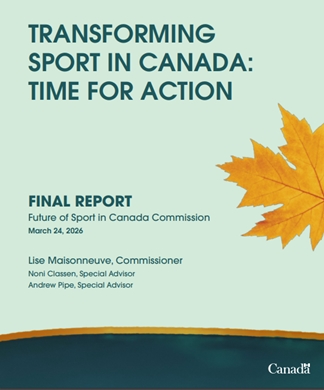
On March 24, 2026, the Future of Sport in Canada Commission delivered its final report to Ottawa. Titled “Transforming Sport in Canada: Time for Action,” the 952-page document represents two years of consultation, testimony, and soul-searching about a system many say has failed both its youngest participants and its elite athletes. The commission was clear from the start: everything would be viewed through a victim- and survivor-centred lens, prioritizing trauma-informed care over podium finishes.
The numbers tell part of the story. The word “safe” appears 1,806 times. “Maltreatment” shows up 851 times. “Victim” and “survivor” combine for nearly 250 mentions. This isn’t a report about tweaking funding formulas or shuffling bureaucrats. It’s a reckoning with decades of what the commission calls a culture of silence, where abuse was dismissed as the price of excellence.
Sport Canada established the commission in May 2024 with a dual mandate: improve safe sport practices and overhaul the entire system’s structure, from policy and funding to governance and accountability. What emerged is a document that challenges nearly every assumption about how we develop athletes, fund programs, and define success.
At the heart of the report lies a rejection of what commissioners call “sport exceptionalism.” For generations, coaches and administrators argued that sport operates differently than schools or workplaces. Pushing athletes to their breaking point was seen as necessary. Public humiliation built character. Training through injury showed commitment. The commission flatly rejects this logic, stating that suffering and humiliation are not prerequisites for podium performances.
Instead, the report proposes three pillars: prevention of maltreatment, effective response when it occurs, and meaningful support for those harmed. Every sport organization would be required to appoint a safeguarding officer, ideally a licensed health professional independent of performance structures. This person would identify potential abuse without waiting for athletes to come forward, addressing the power imbalance that has silenced so many voices.
Critics will immediately ask whether this approach stifles the intensity required for international success. The commission anticipated this concern and offered a pointed rebuttal. When maltreatment is tolerated, public trust erodes. Parents pull their children out of programs. The pipeline of future athletes, coaches, and volunteers dries up. A system built on broken trust cannot sustain itself, let alone produce consistent excellence.
The commission also warns against a potential flood of complaints. Making reporting easier is essential, but the system can’t function if overwhelmed by disputes over playing time or team selection. The report recommends a mandatory triage process to filter out matters that don’t involve actual maltreatment. Organizations would handle administrative grievances internally, while a centralized body tackles genuine abuse allegations.
Crucially, the commission identifies false allegations as a form of maltreatment itself. Authorities would have the power to refuse complaints deemed frivolous or made in bad faith. For less serious cases, the report favours restorative practices that promote learning and accountability rather than purely punitive measures. Coaches, like athletes, deserve procedural fairness: the right to be heard, adequate disclosure, and impartial investigators.
Funding emerged as a crisis point across multiple dimensions. Nearly 44 percent of parents report they cannot afford to register their children in organized sport. The average cost for school-based sport is $70 per person. Participation in a private club averages $1,122. For families already stretched thin, sport has become a luxury rather than a common experience.
The commission calls for targeted subsidies and potential tax exemptions on essential equipment. Past initiatives like the Children’s Fitness Tax Credit had limited impact because low-income families couldn’t afford the upfront costs to claim the credit later. Direct subsidies for activities themselves prove far more effective.
The Community Sport for All Initiative, aimed at removing barriers for Black, Indigenous, racialized, 2SLGBTQI+, and low-income youth, currently faces a 2026 funding expiry. The commission urges immediate extension and expansion. Without stable, long-term support, grassroots programs can’t plan strategically or serve communities consistently.
Indigenous youth face unique challenges, particularly the high costs of travel from remote communities. The Sport for Social Development in Indigenous Communities program provides some support, but participants describe funding as insufficient and short-term. The North American Indigenous Games, for example, lacks permanent funding despite its significance for thousands of young athletes.
School sport, historically the most affordable entry point, is in steep decline. Budget cuts, aging facilities, and a lack of trained staff have gutted programs that once introduced generations of Canadians to physical activity. The commission calls for a national sport infrastructure strategy to modernize facilities and increase community access to underutilized school gymnasiums.
The infrastructure crisis extends beyond schools. A 2019 assessment found that 30 to 35 percent of sport and recreation facilities were in fair condition or worse. Many are over 50 years old and fail to meet modern accessibility standards. Vancouver alone has 8,000 people waiting for swimming lessons due to facility shortages.
The last major federal investment in sport buildings was in 1967. The commission recommends a dedicated federal sport infrastructure program with stable, long-term funding separate from general municipal transfers. Municipalities own and operate 99 percent of Canada’s roughly 78,000 publicly owned recreation facilities, but they lack resources to maintain or upgrade them adequately.
Private for-profit clubs have rushed to fill the gap left by declining public programs. While this provides options for families who can afford them, these clubs often operate with limited oversight and inconsistent safety practices. National Sport Organizations lack resources to monitor them effectively. The commission suggests a verified club program or licensing system where clubs receive benefits like facility access only if they meet governance and safe sport standards.
Municipalities could play a key role by requiring any club renting public space to demonstrate safe sport training and adherence to national standards. This would create a baseline of accountability without imposing heavy-handed regulation.
National Sport Organizations themselves are in crisis. Core federal funding hasn’t increased significantly since 2005. Purchasing power has dropped by an estimated 33 percent due to inflation. NSOs collectively face a deficit of roughly $134 million to $140 million while trying to meet basic mandates.
The consequences are stark. Seventy percent of NSOs have scaled back or eliminated programming. Ninety percent have reduced or cut training camps. Eighty percent have skipped international competitions and increased athlete fees. Many high-performance athletes now crowdfund to cover basic training and travel expenses. Some NSOs fear they won’t make payroll or could shut down entirely without immediate relief.
Approximately 90 percent of NSOs depend heavily on federal funding as their primary income source. Government funding accounts for between 47 and 50 percent of total NSO revenue on average. This dependency makes them highly vulnerable to policy shifts and budget cuts.
The commission proposes centralizing all federal sport and physical activity funding within a single Centralized Sport Entity, structured as a Crown corporation. This model operates at arm’s length from government, reducing political interference while providing more predictable funding. NSOs currently submit duplicate applications to multiple agencies, creating excessive administrative burden. A single entity would simplify this process significantly.
The Crown corporation would use funding as leverage to enforce compliance with national priorities. NSOs already must adopt the Universal Code of Conduct and specific governance standards as conditions of receiving federal funds. The new entity would implement proactive monitoring and auditing to ensure effective use of funds and adherence to safe sport requirements.
NSOs would also face mandatory operational efficiency reviews, including exploring shared services or amalgamation to reduce redundancies. Smaller organizations might merge to achieve sustainability. While this raises concerns about loss of independence, commissioners argue that the current fragmented approach serves neither athletes nor taxpayers well.
The commission recognizes that elite athletes serve as vital role models. Their achievements inspire the next generation and build national pride. But those achievements ring hollow if produced through a flawed system that tolerates heart-wrenching stories of broken dreams and humiliation.
The challenge now shifts to political will. The report calls for a multi-year funding strategy that balances high-performance goals with safety, equity, and accessibility. It requires collaboration across federal, provincial, territorial, and municipal governments. It demands that sport organizations, clubs, and coaches embrace cultural change that won’t come easily.
Some will argue this approach is too heavy-handed, that it introduces bureaucracy where agility is needed. Others will insist the recommendations don’t go far enough, that without enforceable consequences, organizations will continue business as usual. Both critiques deserve consideration as implementation discussions unfold.
What seems beyond dispute is that the current system isn’t working for most Canadians. Families can’t afford participation. Athletes face maltreatment with limited recourse. NSOs teeter on financial collapse. Facilities crumble while demand surges. Marginalized communities remain shut out by cost and access barriers.
The commission delivered its blueprint. The federal government now decides whether to act on it, water it down, or let it gather dust. Sport organizations will lobby for the parts they like and resist the rest. Provinces will negotiate jurisdictional boundaries. Municipalities will plead lack of capacity. The usual dynamics of Canadian federalism will play out in familiar ways.
But this time feels different. The testimonies of survivors, delivered with courage and pain, demand more than symbolic gestures. Parents withdrawing children from programs because they can’t afford fees or fear for their safety represent votes and voices politicians ignore at their peril. NSOs warning they might close their doors aren’t crying wolf; they’re sharing balance sheets that don’t lie.
Canada built a sport system in a different era with different values and different economic realities. That system produced Olympic champions and community programs that served millions. It also produced abuse, inequity, financial crisis, and eroding public trust. The question isn’t whether change is needed. The question is whether we have the collective will to see it through.