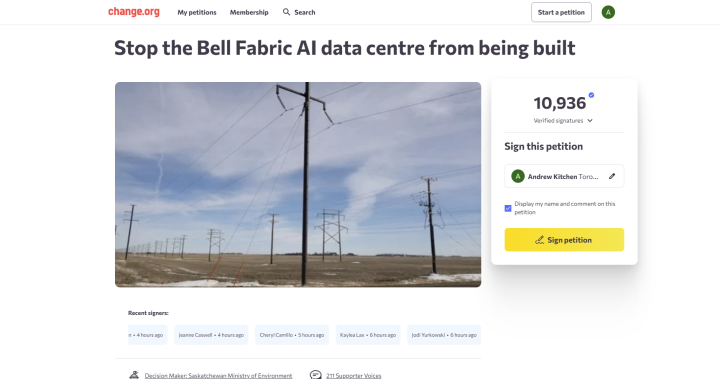
Regina isn’t known for flashy tech protests. Most civic debates here unfold in community halls or via polite letters to council. But something shifted when Bell announced plans for an AI Fabric Data Centre in the city. A 14-year-old named Aya Merroche decided enough was enough and launched a petition.
Within a month, nearly 11,000 people signed it. That’s not a fringe group. That’s roughly one in twenty residents of Regina making their voice heard.
The petition doesn’t mince words. Signatories raise concerns about noise pollution, water consumption, environmental degradation, power demand, and the broader ethical questions surrounding artificial intelligence. These aren’t abstract worries. They reflect what happens when large-scale infrastructure arrives without clear answers to local impact questions.
Dr. Simon Enoch has been tracking this trend across North America. He’s observed a pattern: communities initially welcome tech investment, then grow alarmed once they realize what these facilities actually require. Data centres are not quiet office parks. They demand massive electrical loads, draw heavily on municipal water supplies for cooling, and operate around the clock with industrial-grade ventilation systems.
Regina’s situation mirrors pushback seen in places like Virginia’s Loudoun County and rural Quebec. In those cases, residents discovered that data centres consumed more electricity than entire neighborhoods combined. Cooling systems in some facilities use millions of liters of water annually, straining municipal reserves during drought conditions.
Bell has positioned the AI Fabric Data Centre as an economic opportunity. The company highlights job creation and positions Regina as a player in the global AI economy. But the actual employment numbers for data centres tend to disappoint. Once construction wraps, ongoing operations require relatively few staff. Most jobs are highly specialized, limiting local hiring.
Power consumption is where the friction becomes undeniable. Saskatchewan’s electrical grid relies heavily on natural gas and coal, despite efforts to transition toward renewables. A large data centre adds significant demand at a time when the province is trying to reduce emissions. SaskPower has acknowledged the challenge but hasn’t provided detailed projections on how much additional capacity this facility would require.
Water use is another flashpoint. Regina draws from Buffalo Pound Lake, a source that has faced low levels during dry years. Data centres use water to cool server equipment, and the volume scales with the size of the operation. If Bell’s facility matches industry standards, it could withdraw water at rates comparable to a mid-sized manufacturing plant.
Aya Merroche didn’t wait for official channels to act. She saw an issue, built a petition, and mobilized her community. That’s civic engagement in its rawest form. Her age makes the story more striking, but the substance of the concerns would carry weight regardless of who raised them.
The comments left by petition signatories reveal a range of motivations. Some focus on environmental sustainability. Others worry about noise affecting nearby residential areas. A portion express deeper unease about AI technology itself, questioning whether these systems serve public good or concentrate power in corporate hands.
Dr. Enoch’s research points to a broader disconnect. Tech companies often present data centres as clean, invisible infrastructure. But they’re industrial facilities with tangible impacts. Communities feel blindsided when they learn about energy demands, cooling requirements, and operational realities after approvals are already underway.
Regina City Council hasn’t issued a final decision. Public consultations are expected, but the timeline remains unclear. Bell has representatives meeting with stakeholders, though details of those conversations haven’t been made public. Transparency will determine whether this dispute escalates or finds resolution.
Saskatchewan’s political landscape complicates the picture. The provincial government has been courting tech investment as part of economic diversification efforts. Premier Scott Moe has championed data infrastructure as a growth sector. That creates pressure on municipal leaders to approve projects even when local residents raise valid concerns.
The petition also touches on AI ethics, a conversation that extends beyond Regina. Artificial intelligence systems require enormous computational resources, which is why companies build these facilities. But the question of what those systems do, who controls them, and how they affect labor markets and privacy hasn’t been settled. Regina residents are asking those questions now, not after the fact.
Noise pollution is less abstract than it sounds. Data centres run continuous cooling and ventilation systems. Depending on proximity to residential zones, that hum becomes a constant presence. In other jurisdictions, residents have reported sleep disruption and property value declines near data facilities.
Bell hasn’t released a comprehensive environmental impact assessment accessible to the public. That absence fuels skepticism. When companies withhold detailed plans, communities assume the worst. Transparency builds trust. Opacity breeds opposition.
Aya Merroche’s petition has done what many formal consultation processes fail to achieve: it captured public sentiment in real time. Nearly 11,000 signatures represent a constituency that municipal and provincial leaders cannot ignore. Whether they choose to listen is a different matter.
Regina is not anti-development. The city has welcomed investments in agriculture tech, renewable energy projects, and urban infrastructure. But residents expect their quality of life to be part of the equation. They want guarantees that water supplies won’t be strained, that emissions won’t spike, and that their neighborhoods won’t bear the cost of corporate growth.
Dr. Enoch’s observations suggest this is a turning point. Communities are no longer accepting data centres as neutral infrastructure. They’re demanding accountability, environmental safeguards, and genuine local benefit. Regina’s pushback is part of that shift.
The outcome here will set precedent. If Bell proceeds without addressing community concerns, it signals that corporate interests outweigh civic input. If the project is revised or relocated based on public feedback, it demonstrates that grassroots organizing still has power.
For now, the petition circulates. The signatures grow. And Regina waits to see whether its voice will be heard or drowned out by the hum of servers.