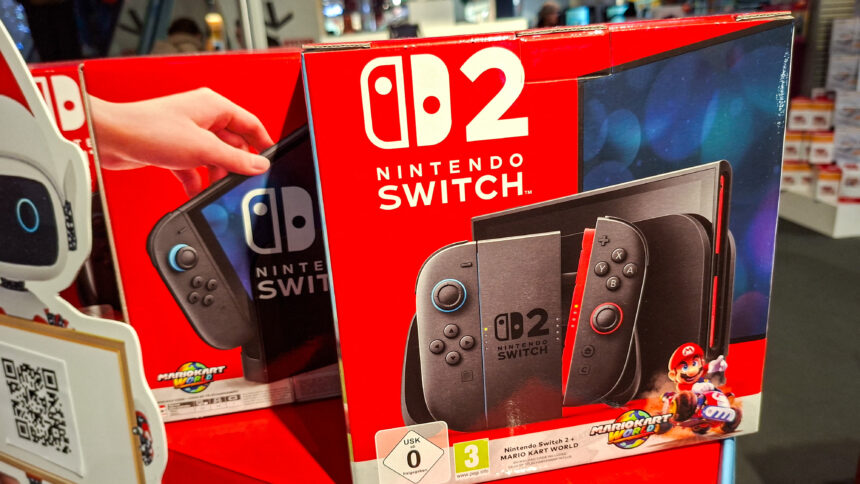
The price tag on your Nintendo Switch 2 — C$629 here in Canada — already felt steep when it launched last June. What many shoppers didn’t know was how much of that sticker shock was rooted in a trade war playing out entirely south of the border. Now, the company behind the Switch 2 is fighting back in court, and the battle is one every Canadian consumer who bought a console, an accessory, or just watched prices creep up in 2025 should understand.
On March 6, 2026, Nintendo of America filed a lawsuit in the U.S. Court of International Trade against multiple federal agencies, including the U.S. Department of the Treasury, the Department of Homeland Security, the Office of the U.S. Trade Representative, U.S. Customs and Border Protection and the Department of Commerce. The company is demanding a full refund of all duties paid under tariffs imposed through U.S. President Donald Trump’s use of the International Emergency Economic Powers Act of 1977, plus interest and attorney fees. The legal ground appears solid: on Feb. 20, 2026, the U.S. Supreme Court ruled that Trump did not have the authority to impose tariffs via IEEPA, rendering those duties unlawful.
As of March 13, 2026, Nintendo’s lawsuit has been automatically stayed — paused pending the outcome of a broader IEEPA case before the U.S. Court of International Trade. It is expected to resume once that case is resolved.
The tariff chaos hit Canada in real time. When Trump announced his sweeping trade policy in early April 2025, Nintendo delayed pre-orders for the Switch 2 — not just in the U.S. but in Canada as well. Nintendo of Canada cited a need to “align with the timing of pre-orders to be determined in the U.S.” The company eventually confirmed that pre-orders for both countries would begin on April 24, 2025, with the console price holding steady. Although, some accessories had already received price increases of US$5 to US$10 per item.
To protect the console’s launch price in the U.S., Nintendo redirected much of its Vietnam-manufactured inventory south of the border, where certain tariff rates were more favourable — a logistical manoeuvre that had downstream effects on Canadian supply and perception.
The broader impact on Canadian consumers came in waves: in August 2025, Nintendo raised the price of legacy Switch hardware across Canada due to what the company described as “market conditions.” The Switch OLED went up $50, the standard Switch by $40 and the Switch Lite by $30.
Nintendo is not alone. More than 1,000 companies, including Costco, FedEx, L’Oréal, Dyson, Revlon, Bausch & Lomb and CVS, have filed similar lawsuits in the U.S. Court of International Trade, collectively targeting what they argue are illegally collected duties. According to Nintendo’s complaint, the tariffs resulted in the collection of more than US$200 billion in duties on imports from nearly all countries since February 2025. U.S. Customs and Border Protection separately disclosed that it collected approximately US$166 billion in IEEPA tariffs specifically, spanning more than 330,000 importers and over 53 million entries.
Judge Richard Eaton, overseeing roughly 2,000 tariff refund lawsuits in the trade court, ruled on March 5 that companies are entitled to refunds — but U.S. Customs and Border Protection said it cannot immediately comply with that order. The agency estimates it will need approximately 45 days to build a new electronic system to begin processing repayments.
For Canadian households, the impact of the broader U.S. tariff regime has been significant. According to economists tracking the 2025 to 2026 tariff cycle, Canadian households absorbed an estimated C$1,700 to C$2,000 in higher annual costs — a squeeze that arrived from both directions: retaliatory Canadian tariffs pushed up prices on imported American goods, while U.S. tariffs weakened exports from Canadian industries that employ hundreds of thousands of workers. A December 2025 Leger survey found that 82% of Canadians said the tariffs had a very or somewhat significant impact on the Canadian economy, and 56% said the tariffs had a significant impact on their personal household finances.
Despite these pressures, Canada’s economy proved more resilient than many economists initially predicted. Canada’s gross domestic product grew 1.7% in 2025, aided largely by the Canada-U.S.-Mexico Agreement exemption, which shielded most Canadian exports from the full brunt of U.S. tariffs — particularly after CUSMA compliance reached a 20-year high by July 2025.
That is the central question — and the honest answer is: not automatically. Nintendo’s legal fight is between the company and the U.S. government. Even if Nintendo wins a full refund, it is unclear whether those savings will flow back to consumers. Companies like FedEx have indicated they will issue refunds to customers if and when they receive their own reimbursements from the government — but both say they cannot act until courts and regulators clarify next steps.
Meanwhile, the broader tariff picture remains unsettled. After the Supreme Court struck down the IEEPA tariffs, Trump moved to impose a new 15% global tariff under Section 122 of the Trade Act of 1974, a provision that allows tariffs of up to 15% for a maximum of 150 days to address trade deficits. More than two dozen U.S. states have already challenged those tariffs in court. For Canadian exporters and consumers, this ongoing uncertainty means the economic disruption of 2025 is unlikely to reverse quickly, regardless of how Nintendo’s legal case unfolds.
You may not be able to recoup the extra dollars you paid for Switch 2 accessories last year, but the Nintendo lawsuit and the broader tariff drama offer a clear lesson: trade policy is a personal finance issue — and being an informed consumer matters.
Track prices on major purchases. Big-ticket electronics like gaming consoles are subject to tariff-driven price volatility. Websites that track historical pricing, such as camelcamelcamel.com, can help you identify whether today’s price reflects genuine value or an inflated post-tariff market.
Understand where your money goes. When a product is made in a country that is subject to high tariffs, some of that cost is absorbed by the manufacturer, some by the retailer and some by you. Knowing this helps you push back — or wait.
Watch for refund policies. If the companies suing the U.S. government eventually win and pass savings on to consumers, that could include shipping refunds from FedEx or price adjustments on accessories. Follow the retailers you shop with to see if they communicate any tariff-related credits.
Diversify away from tariff-exposed categories. If trade war volatility worries you, consider delaying non-essential electronics purchases until the legal and trade situation stabilizes. Canadian retailers are increasingly stocking domestic and non-U.S.-sourced alternatives.
Stay informed on CUSMA. The Canada-U.S.-Mexico Agreement is up for review in 2026. Its outcome will shape the long-term cost of thousands of everyday goods. Monitoring proceedings through the Government of Canada’s trade website takes minutes and could help you anticipate changes before they hit your household budget.