Sunday night turned tragic at New York’s LaGuardia Airport when an Air Canada Express jet collided with a fire truck on the runway. The crash killed both pilots and sent dozens to hospitals across Queens.
The plane carried 76 people total. All 72 passengers and four crew have been accounted for, according to Kathryn Garcia. She runs the Port Authority that oversees the airport. Both pilots died on impact and were based in Canada.
Garcia spoke to reporters early Monday morning. She confirmed 41 people went to two Queens hospitals. Most were released quickly, but nine remained in care. Some faced serious injuries. Two Port Authority workers riding in the fire truck also got hurt but survived.
The aircraft was a CRJ-900 regional jet. Jazz Aviation operates it under the Air Canada Express brand. The flight number was AC8646, and it had just arrived from Montreal.
Air Canada released a statement expressing deep sadness. The airline sent officials to LaGuardia to help investigators. They offered condolences to the families of the Jazz employees who died.
The collision happened just after 11:30 p.m. The plane had touched down after flying from Pierre Elliott Trudeau International Airport. That’s Montreal’s main airport serving millions of passengers each year.
The fire truck wasn’t responding to the Air Canada flight. It was handling a separate emergency involving a United Airlines plane. That aircraft had aborted takeoff after crew reported a strange smell onboard.
Garcia didn’t share details about what led to the crash. She said the National Transportation Safety Board would handle those questions. Federal investigators took the lead on figuring out what went wrong.
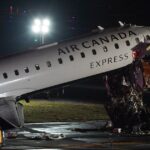
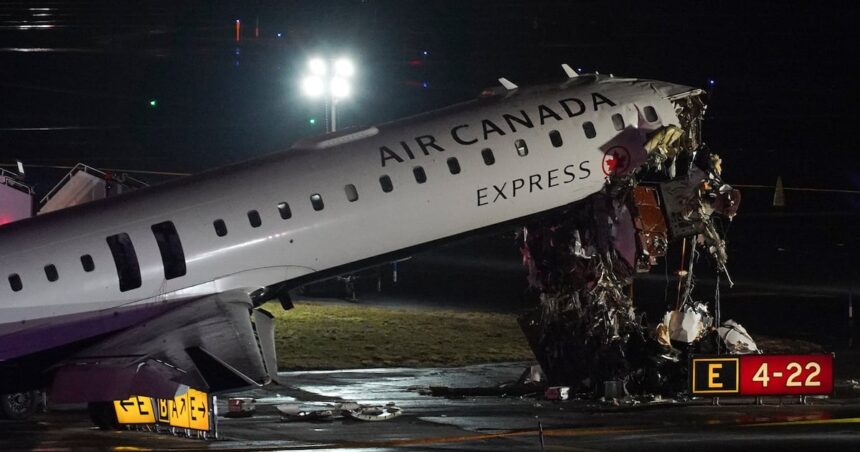
Photos from the scene show shocking damage. The jet sits on its tail with its nose pointing skyward. The cockpit was peeled back to the windows. Wires and controls hung exposed in a tangled mess. Red emergency vehicles surrounded the plane under portable floodlights.
Evacuation stairs were pushed against the emergency exits. The white fuselage still displayed Air Canada Express markings. The jet’s tail bore the airline’s livery too. Nearby, a bright yellow fire truck lay on its side, heavily damaged.
Air traffic control recordings paint a tense picture. Controllers were busy managing the United Airlines emergency before the crash. Flight attendants on that plane felt sick from the odour. Controllers were arranging stairs in case passengers needed to get off.
Then something went wrong fast. One controller gave a vehicle permission to cross the tarmac. Moments later, that same controller tried to stop it. “Stop, Truck 1. Stop,” the audio captures. The controller then scrambled to wave off incoming planes.
After the collision, two staffers tried to process what happened. “That wasn’t good to watch,” one said. The other replied they’d been dealing with the earlier emergency. “You did the best you could,” came the response.
The CRJ-900 is a regional workhorse. Airlines use it to connect smaller cities to major hubs. It seats 76 to 90 passengers on short and medium routes. The design is distinctive: narrow body, rear engines, and a T-shaped tail.
LaGuardia remained closed until at least 2 p.m. Monday. Some passengers who arrived hours early hoping to skip security lines left disappointed. They rebooked for Tuesday or rushed to other airports. Some drove as far as Long Island MacArthur in Ronkonkoma.
The airport sits in Queens on Flushing Bay’s edge. It serves mostly domestic flights and ranks among America’s busiest. LaGuardia placed 19th in 2024 among over 500 U.S. airports. More than 16.7 million passengers boarded there that year.
Canadian Transport Minister Steven McKinnon posted on social media about the crash. He said Canada was working closely with American investigators. “Aviation safety remains our highest priority,” McKinnon wrote.
The investigation will take time. The NTSB typically spends months reviewing evidence before issuing findings. They’ll examine the flight recorders, interview survivors, and reconstruct the sequence of events.
Regional jets like the CRJ-900 have solid safety records overall. But airport ground operations involve constant coordination. Dozens of vehicles move across tarmacs while planes land and take off. Controllers juggle multiple emergencies and routine traffic simultaneously.
LaGuardia handles heavy volume given its Manhattan proximity. Two intersecting runways manage constant arrivals and departures. The airport underwent major renovations in recent years to modernize aging terminals.
Sunday’s tragedy marks a rare collision between aircraft and ground vehicles. Most runway incursions end without injury thanks to alert controllers and pilots. This crash shows how quickly things can go wrong when systems break down.
The families of the two Jazz Aviation pilots now face unimaginable loss. Their colleagues at Air Canada Express and the broader aviation community mourn alongside them. The injured passengers face long recoveries, both physical and emotional.
Questions remain about communication breakdowns and decision-making that night. Why did the fire truck cross an active runway? Did controllers have full visibility of ground traffic? Were there gaps in coordination protocols?
The NTSB will answer those questions eventually. For now, dozens of families process trauma and grief. Two pilots won’t return home to Canada. Survivors replay those terrifying moments when their plane struck the truck.
Aviation remains statistically safe, but tragedies like this remind us why vigilance matters. Every takeoff and landing involves countless decisions. Controllers, pilots, and ground crews must work in perfect sync. One miscommunication can have devastating consequences.
LaGuardia will reopen and flights will resume. Investigators will file reports and recommend changes. But the families affected by Sunday’s crash will carry this night forever. Two lives lost, many more changed, all in seconds on a routine arrival.