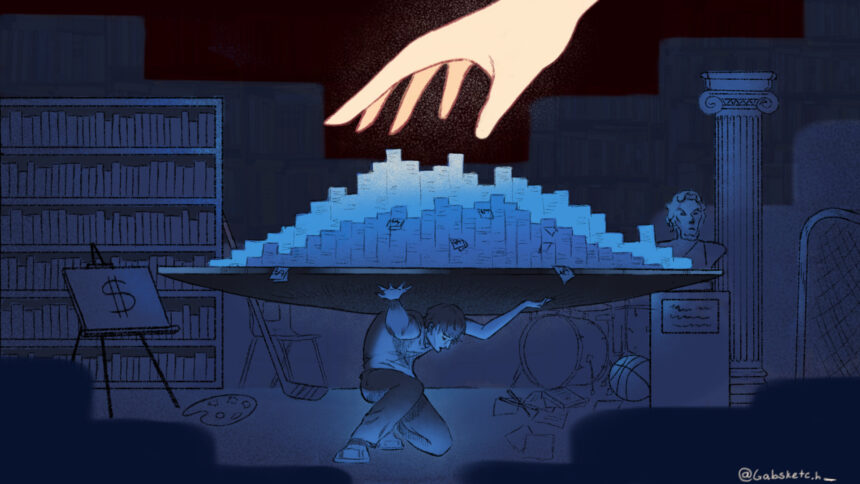
When Salaar Khan opened his admission letter last year, he thought he understood the bargain. Work hard, take on some debt, graduate with a degree that would be worth the investment. The math seemed doable then. Ontario Student Assistance Program funding leaned heavily toward grants, not loans. Khan could borrow what he needed without spending the next decade paying it back.
That calculation changed in February. The Ontario government slashed non-repayable grants from a maximum of 85 per cent down to just 25 per cent. Students who once borrowed a quarter of their funding now face loans covering three-quarters of their costs. For Khan and thousands like him, the path forward just got steeper.
More than two-thirds of Ontario postsecondary students rely on OSAP to cover tuition, rent, and groceries. The policy shift announced on February 12 didn’t just tweak the numbers. It fundamentally altered the risk students take on when they pursue higher education. What felt manageable now feels precarious.
This isn’t just about money changing hands. It’s about who gets to walk through the door in the first place.
Building a portfolio before you can afford one
University admissions offices like to talk about merit. They assess grades, leadership roles, research experience, community involvement. But merit isn’t built in a vacuum. It requires time, transportation, equipment, and often unpaid labour.
High school students from financially stable homes can spend their summers volunteering at labs or leading clubs. Students from lower-income families often work to support themselves or their households. Both groups might be equally capable, but only one gets to build the kind of resume that opens doors to competitive programs like engineering sciences at the University of Toronto.
Statistics Canada data from 2001 to 2022 shows the gap clearly. In 2022, about 75 per cent of 19-year-olds from the top income bracket enrolled in university. Among the bottom income group, that number dropped to 43 per cent. A 2019 report from the Higher Education Quality Council of Ontario confirmed what many already knew: wealthier students access academic streams more easily and land better jobs afterward.
First-generation students face additional hurdles. These are young people whose parents didn’t attend postsecondary school. As of 2023, only 18 per cent of first-generation students enrolled in undergraduate programs, compared to 32 per cent of students with degree-holding parents. A 2022 University of British Columbia survey found that 75 per cent of first-generation respondents struggled to pay tuition and living expenses. Many also reported feeling academically underprepared, disconnected from campus life, and burdened by family expectations.
Even applying to university costs money. The Ontario University Application Centre charges a base fee of $156 for three schools. Want to apply to more? Pay extra. Nearly 40 per cent of UBC survey respondents said they struggled with application fees alone.
Merit-based admissions sound fair until you realize merit itself is unevenly distributed long before anyone fills out an application form.
Passion versus paycheque
Once students actually enrol, financial pressure doesn’t ease. It intensifies. Students are told to follow their interests while also preparing for stable careers. That balance becomes nearly impossible when loans replace grants.
April Huynh, a first-year engineering student, felt the push early. She wanted to study art but was steered toward STEM fields instead. The message was clear: art doesn’t pay bills. Engineering does.
Ontario Premier Doug Ford reinforced that message recently when he criticized federal spending on what he called “basket-weaving courses.” He argued that students should focus on “jobs of the future” in healthcare, trades, and STEM fields. Anyone pursuing humanities or social sciences, he suggested, risked becoming a “college-educated barista.”
Julia Boyd teaches English and drama at the University of Toronto Mississauga. She finds Ford’s comments both misleading and damaging. Humanities programs teach research, critical thinking, and communication skills that every workplace needs. Lawyers need to build arguments. Teachers need to connect with students. Even engineers benefit from clear writing and ethical reasoning.
Boyd worries that students will avoid valuable courses because politicians tell them those subjects are worthless. If that happens, the next generation of workers will lack the versatility that once defined a university education.
Financial pressure already narrows students’ choices. Political rhetoric makes it worse. Students end up chasing imagined security instead of developing the broad skillset employers actually value.
Graduate school on pause
Even after earning a degree, financial barriers persist. Sofiya Salakhutdinova, a third-year molecular biology student at UTM, once planned to start a master’s program right after graduation. Now she’s reconsidering.
With reduced OSAP grants, Salakhutdinova may need to work for a year or more to save enough money for graduate school. But gaps in academic training can slow research progress and weaken professional networks. She’s caught between two bad options: take on crushing debt or delay her career.
Graduate funding hasn’t kept pace with living costs. The Canada Graduate Research Scholarship increased to $27,000 per student in 2024, but that amount still falls below the poverty line for a single person. In Toronto, where rent climbs relentlessly, $27,000 barely covers housing and groceries, let alone tuition or research materials.
Funding also varies wildly by discipline. Some fields attract large research grants. Others compete for scraps. Teaching and research assistant positions are limited, and support depends heavily on individual supervisors and departmental budgets.
When academic advancement requires financial risk, opportunity narrows. Students like Salakhutdinova must calculate not just whether they’re capable of graduate work, but whether they can afford the gamble.
Who really benefits from higher education?
Universities promote diversity in their recruitment materials. They point to enrolment numbers as proof of equity. But those numbers don’t capture the obstacles students overcame to get there. Application fees, extracurricular costs, family income, parental education levels, and the looming threat of debt all shape who applies and who succeeds.
Institutions could reduce those barriers. They could waive application fees for low-income students, value paid work as much as unpaid volunteering, and provide more transparent funding structures. But most Ontario universities operate like businesses. They need tuition revenue to function. Reducing financial barriers often conflicts with institutional budgets.
OSAP was designed to bridge that gap. It allowed universities to charge tuition while ensuring students could still afford to attend. The February policy shift undermines that purpose. By prioritizing loans over grants, the government shifted financial risk from the public sector onto individual students.
Premier Ford framed the cuts as fiscal responsibility. But the real cost isn’t measured in budget lines. It’s measured in lost potential. Students who can’t afford to apply. Talented researchers who delay graduate school. Young people who abandon their interests because they can’t risk pursuing them.
Access to higher education shouldn’t depend on how much financial risk a teenager can tolerate. It should depend on ability, curiosity, and effort. Right now, the system works differently. Wealth determines who gets to explore new ideas, build professional networks, and pursue advanced training.
Universities can’t fix this alone. They operate within a funding structure shaped by provincial policy. But they also have choices. They can advocate for better student aid. They can redesign admissions to value diverse experiences. They can commit resources to first-generation students and low-income families.
The current trajectory moves in the opposite direction. Grants shrink. Loans grow. Barriers rise. Students like Khan, Huynh, and Salakhutdinova adapt as best they can, but adaptation isn’t equity. It’s survival.
Higher education promises opportunity. For too many students, that promise now comes with an impossible price tag.