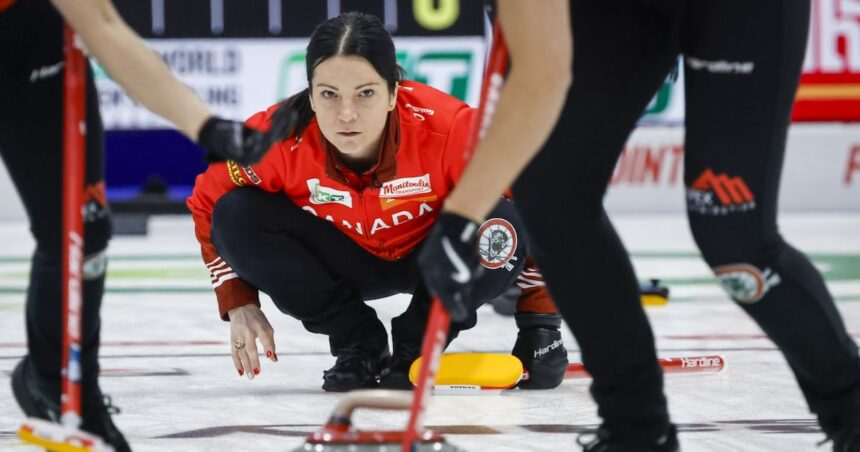
The roar inside Calgary’s WinSport Event Centre told you everything about what this moment meant. Kerri Einarson and her rink had just punched their ticket to the world curling semifinals with a tense 6-5 victory over Japan, and the crowd wasn’t holding back.
For Einarson, that noise was a gift. Her last world championship in this building back in 2021 played out in silence under pandemic restrictions. Now, with fans packed in and every strategic call echoing off the rafters, she could finally feel what representing Canada at home should sound like. “It’s so loud,” she said afterward. “I love it.”
Canada wrapped up pool play Friday with a 10-2 record, trailing only Switzerland’s unbeaten 11-1 mark. Both teams earned direct entry into Saturday evening’s semifinals. The Swiss will face either Sweden or South Korea, while Canada awaits the winner of a playoff between Japan and Turkey. Medal games are set for Sunday.
Einarson’s squad from Gimli Curling Club in Manitoba showed playoff-level sharpness against a formidable opponent. Japan’s Satsuki Fujisawa took Olympic silver in 2022 and brought that pedigree into Friday’s matchup. The Canadians knew they had to elevate their game.
Third Val Sweeting led the charge with a stunning 99 percent shooting accuracy, her tournament high at that position. Second Shannon Birchard hit 93 percent, and lead Karlee Burgess posted 97 percent. Those numbers reflected more than just skill. They showed a team firing on all cylinders at the right time.
“We definitely upped it this game,” Einarson said. “We knew we had to. Japan’s a wonderful team.”
The skip delivered when it mattered most. Her last throw in the eighth end threaded through a tight port for a double takeout that scored two points and stretched Canada’s lead to 6-3. In the sixth end, her triple takeout added another deuce. Even her defensive play in the third end, a wide double hit, limited Japan to a single point.
Sweeting’s line calling and the front end’s precise brushing amplified every shot. The team’s rock placement put constant pressure on their opponents. A couple of stones slid deeper than planned, but Canada avoided full misses. Every throw delivered something useful.
“Right from lead to skip, we played really well and put a lot of pressure on them,” Einarson said. “Very good rock placement. We got something out of every shot and I think that’s key.”
The performance marked a sharp rebound from Thursday evening’s extra-end loss to Norway. Before facing Japan, Canada demolished Australia 11-2 in the afternoon draw. That two-game stretch showed the team’s ability to shake off disappointment and refocus quickly.
Sweeting acknowledged her own journey through the tournament. Her shooting percentage dipped below 80 percent during three mid-tournament games. She kept grinding through those struggles, trusting her teammates to manage the ice and keep throws accurate.
“I felt kind of close all week and just wasn’t always getting them,” Sweeting said. “But I thought that we did a good job of figuring them out and managing them well.”
When Friday’s semifinal qualifier demanded her best, she delivered. Her Japanese counterpart Tori Koana shot 75 percent at the same position. That 24-point gap in accuracy made the difference in a one-point game.
“It was nice to get those results and make those shots when the team needed them,” Sweeting added.
Canada’s second-place finish in pool play carries practical benefits beyond bragging rights. After playing eight games in four days, including three consecutive days of morning and evening draws, Einarson’s team earned a breather. They get Saturday morning off while Japan, Turkey, Sweden, and South Korea battle for the final two semifinal spots.
“It’s a relief. It feels quite nice actually,” Einarson said. “It’s still like sudden death and we still have a job to do. We’re definitely excited and ready for it.”
The shorter path to the semifinals represents a change from recent years. In both 2022 and 2023, Einarson, Sweeting, and Birchard (then playing with lead Briane Harris) finished third in pool play and took the longer route to bronze medals. This year’s direct entry gives them a strategic advantage and extra rest.
Canada’s pursuit of a world championship carries both promise and pressure. Rachel Homan captured back-to-back titles for Canada in 2024 and 2025, setting a high bar. Einarson’s rink won their first Canadian championship in 2020, but the pandemic cancelled that year’s worlds before they could compete.
Since then, they’ve collected bronze medals but not gold. This tournament offers another chance to break through.
Turkey’s appearance in the playoffs adds an intriguing storyline. Dilşat Yıldız led her rink to a 7-5 record in her fifth appearance at the women’s worlds, marking the first time Turkey has advanced to playoff games at this championship. Their matchup with Japan promises competitive curling.
Sweden and South Korea both finished pool play at 8-4, setting up another tight playoff battle. The winners of those Saturday afternoon games will face rested opponents in Canada and Switzerland, who have been watching and preparing.
Japan will likely target a rematch with Canada. Fujisawa’s team showed enough skill and composure Friday to believe they can flip the result with another chance. Canada’s small margin of victory suggests nothing is guaranteed.
For Einarson and her teammates, the noise in Calgary represents more than just crowd support. It’s validation of their journey and recognition of what’s at stake. After years of near misses and bronze medals, they’re one step closer to the championship they’ve been chasing.
Sunday’s medal games will determine whether that step becomes a leap. But for now, Canada can enjoy what Friday delivered: a hard-fought win, a direct path to the semifinals, and the sound of home-country fans believing in what comes next.